.jpg)
September 2025 marked a qualitative shift in the Lebanese scene. Discussions surrounding Hezbollah’s weapons moved from theoretical debate to
the level of executive decision-making — as reflected in the Lebanese Army’s proposal, presented at a Government session devoted to the issue of “confiscating all weapons under state authority.”
Hezbollah and its media outlets portrayed the session as a retreat by the government from previous positions regarding the party’s arms.
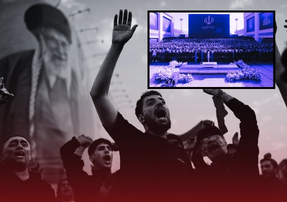
This development coincided with continued Israeli military escalation and repeated air raids on South Lebanon and the Beqaa Valley. Meanwhile, Hezbollah focused on symbolic and media mobilization, organizing religious, social, and cultural events emphasizing “the symbolism of resistance” and “loyalty to the late Secretary-General Sayyed Hassan Nasrallah.”
The Weapons-Control Plan
During the September 5, 2025 government session, the Lebanese Army presented its first comprehensive plan to confine weapons exclusively to the state’s authority — the first detailed military proposal of its kind.
Opposition-aligned media outlets reported that the plan would proceed gradually, starting from areas south of the Litani River, later extending northward to include the Beqaa and Beirut’s southern suburbs (Dahieh). The implementation period was said to span 15 months, with monthly reports to the government. The initial phase was scheduled to begin by the end of the year.
In contrast, media close to Hezbollah emphasized the Army’s acknowledgment of shortages in equipment and funding, and its linkage of implementation to an end to Israeli aggression and withdrawal from occupied Lebanese territories (the “five points,” later expanded to seven).
Ministers from Hezbollah and the Amal Movement withdrew from the session, as they had done in a previous one.
The government approved the plan and decided to keep its contents confidential, stressing that it constituted the execution of resolutions made in the August 5 and 7 sessions.
Hezbollah’s Political and Media Position
Hezbollah’s official and media responses to the “Weapons-Control Plan” included the following themes:
- Party statements and MPs’ remarks reiterated that “the resistance’s weapons are essential” and that Lebanon would lose its strength if it relinquished its “resistance capabilities.”
- Party-aligned media (Al-Manar TV, Al-Ahed website, and Al-Akhbar newspaper) framed the government’s decisions as “a dangerous mistake leading the country to the brink of internal strife.”
- Coverage emphasized the sacrifices of the martyrs and accused government opponents of disregarding them to satisfy American pressure.
- Focused criticism was directed at Prime Minister Nawaf Salam, whom Hezbollah-affiliated outlets depicted as implementing “American-Israeli directives.” Meanwhile, the President of the Republic was spared from criticism — in a deliberate rhetorical strategy that contrasted “dignity and loyalty to blood” with “submission, impulsiveness, and personal vendetta.”
Despite withdrawing from the government session, Hezbollah sought to frame its move as a measured effort to avoid domestic confrontation, emphasizing through its media that “the resistance will not be dragged into internal conflict.”
Public mobilization in Beirut’s southern suburbs remained limited, largely confined to motorcycle rallies and small symbolic gatherings.
The Lighting of Raouche Rock
A major public controversy erupted in Beirut after organizers of the “Anniversary of the Martyrdom of the Two Secretaries-General of Hezbollah — Sayyed Hassan Nasrallah and Sayyed Hashem Safieddine” announced their intention to project images of the late Hezbollah Secretary-General onto Raouche Rock, Beirut’s most iconic seaside landmark, using large-scale light projectors.
Opponents condemned the plan as a political provocation and an attempt to impose Hezbollah’s presence in the heart of the capital. Hezbollah’s media, in contrast, described it as a “spontaneous gesture of loyalty by citizens” and denied that the party itself had organized the event.
The Prime Minister’s Office and the Beirut Municipality requested prior authorization for the event. An agreement was reached permitting a limited gathering without road closures, under the sponsorship of a Hezbollah-affiliated cultural organization, Ressalat.
Nevertheless, Hezbollah mobilized its supporters and proceeded to light up the rock, defying the Prime Minister’s and Beirut Governor’s decision, and violating its earlier commitment.
The incident turned into a symbolic standoff: between the state’s attempt to assert civilian authority in the capital and Hezbollah’s assertion of its own legitimacy in the public sphere.
Hezbollah activists, in the presence of senior official Wafiq Safa, celebrated the successful illumination of the rock as evidence that the government could not prevent it, implying that the state would likewise be unable to enforce its weapons-control plan.
Other Activities and Events
Hezbollah held major commemorative ceremonies across southern and Beqaa towns for “The Master of the Martyrs of the Nation” — a title now attributed to the late Secretary-General Sayyed Hassan Nasrallah.
- Religious sermons invoked Nasrallah’s final “testament” emphasizing steadfastness and unity, portraying him as a national and spiritual martyr.
- Hezbollah media linked his memory to “loyalty to the blood that established the deterrence equation.”
- The party organized economic and cultural exhibitions in Zahle and Hermel — such as “The Bounty of Al-Mahdi Exhibition” — promoting the concept of “resistant self-sufficiency.”
- Funerals for members killed in Israeli airstrikes or deceased naturally (e.g., Rida Zreiq, Ali Abbas Ghazaleh, Hassan Siblani) were transformed into mass mobilization events, reiterating that the “resistance lives in both land and conscience” and that “attempts to disarm it will not erase its legacy.”
- Shiite clerics supportive of Hezbollah (Ahmad Qabalan, Ali Fadlallah, Ali al-Khatib) delivered sermons blending religious and political discourse, emphasizing the duty to stand by the “resistance.”
- Hezbollah delegations visited prominent religious figures such as Sayyed Ali Fadlallah and Sheikh Ahmad al-Qattan, reaffirming Islamic unity.
- A delegation from the Iranian Shura Council, headed by Ali Larijani, visited the mausoleum of Sayyed Hassan Nasrallah — a highly symbolic act underscoring Hezbollah’s regional alliances.
Emphasis on Symbolism
The commemoration of Sayyed Hassan Nasrallah evolved into an ideological framework reinforcing the legitimacy of Hezbollah’s arms against the backdrop of the government’s disarmament initiative.
The party presented itself as both a victim targeted by Israel and the West and the sole defender of the South and Shiite communities — against both the Lebanese government’s decisions and Western “dictates.”
Ultimately, Hezbollah succeeded in shifting the battlefield to the symbolic and media arenas, using the “Memory of Sayyed Hassan Nasrallah” as a unifying emblem to consolidate internal support and reaffirm the legitimacy of the resistance.
At times, a subtle divergence could be detected between Hezbollah and the Amal Movement, which refrained from overtly challenging government decisions or the army’s plan, opting instead to maintain its image as Hezbollah’s political ally without direct confrontation.