Key Issues
Debate over Hezbollah’s Weapons
According to various media reports, the American proposal carried by envoy Thomas Barrack focused on consolidating all weapons in Lebanon under state authority, with binding timelines that most press accounts suggested should not extend beyond the end of the year.
Curbing Financial Flows to Hezbollah
The United States emphasized the need to halt the flow of funds to Hezbollah, specifically by pressing to shut down Al-Qard al-Hassan, the financial institution affiliated with the group.
Tensions with UNIFIL in Southern Lebanon
Southern Lebanon witnessed tensions following media and “popular” accusations that UNIFIL was monitoring Hezbollah’s movements and relaying information to Israel. Several field clashes with UNIFIL patrols occurred—none claimed by Hezbollah, though the party’s media justified them by stressing that these patrols were operating without Lebanese Army escorts.
Israeli Military Escalation
Israel carried out near-daily airstrikes using drones and fighter jets targeting the South, the Bekaa, and even Beirut’s outskirts. According to the Israeli military, the strikes hit Hezbollah leaders and operatives, as well as targets linked to the Quds Force and Hamas. Hezbollah’s media, along with Amal’s, emphasized that these raids violated the ceasefire and highlighted the Lebanese government’s inaction. Party outlets also portrayed the victims as Lebanese civilians without acknowledging their combatant status, despite Hezbollah conducting most funerals under their military designations.
A notable development was Israel’s intensification of limited ground incursions (in Kfarkila, Aitaroun, and Khiam), demolition of homes near the border, and precision strikes against field commanders (from the Radwan Force, naval units, artillery and fire management, and the Quds Force).
Hezbollah issued no explicit threats of direct retaliation during this month, but several press reports pointed to heightened alert levels across all fronts, evacuation of positions, and preparation for a possible large-scale Israeli assault.
Armed Presence in Beirut
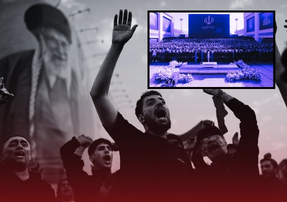
The appearance of armed men during Ashura processions in Beirut stirred political and security controversy, with some interpreting it as political signaling and direct threats of escalation. The Lebanese Army conducted several arrests of participants identified in circulating video footage.
Key Positions
Within the Shiite Arena
- Hezbollah
- Refusal to Disarm: Maintaining its firm stance that resistance arms are a red line, to be relinquished only once occupation ends and aggression ceases. Hezbollah frames its arsenal as a tool to defend Lebanon and deter Israel, not for internal domination. With strong backing from Amal, the party argued that disarmament demands endanger Lebanon’s security and serve Israeli and American agendas. Its media escalated rhetoric with emotive language and accusations of incitement against other Lebanese factions.
- Confrontation with the U.S.: Accusing Washington of seeking to divide Lebanon in Israel’s favor, describing the American proposal as part of a long-standing project to dismantle the resistance.
- Escalatory Rhetoric: Leaders and public figures (Naïm Qassem, Ali Fayyad, Hussein Mousawi, Ihab Hamadeh, Hussein Jishi) insisted that defense strategy is a domestic matter and that weapons will remain for future generations, stressing permanent readiness.
- Financial Domain: Defending Al-Qard al-Hassan as a charitable institution, while continuing to organize Ashura marches and gatherings despite internal criticism.
- Internal Restructuring: Reports indicated the merging of jihadist units, the dissolution of the Liaison and Coordination Unit (headed by Wafiq Safa), and the creation of committees to review the organization’s political and social role.
- Amal Movement
- Alliance with Hezbollah: Maintaining full coordination on the weapons issue and negotiations.
- On Hezbollah’s Arms: Amal’s positions were less rigid than Hezbollah’s. Media reports suggested Speaker Nabih Berri adopted a more flexible stance on restricting arms to the state, focusing instead on securing preliminary guarantees for gradual disarmament if Israel were to take encouraging steps.
- Berri as Mediator: Played a central role in liaising with the U.S. envoy, reportedly offering conditional assurances on the weapons file, which earned Washington’s satisfaction with the negotiation process.
- Expatriate Voting: Insisting that expatriate voting law should not merge the six expatriate seats into the general pool of 128 deputies, arguing this was necessary to preserve Shiite bloc unity and exclusive representation.
- Shiite Clerics Close to the Duo
Figures such as Mufti Ahmad Qabalan and Sayyed Ali Fadlallah framed Hezbollah’s weapons as a national strength. Others warned of the dangers of internal division and its threat to national unity. - Shiite Opposition
Opposition voices within the Shiite community stressed the need to address Hezbollah’s arms within the framework of the constitution and state authority, insisting that only the state should hold the monopoly over arms on Lebanese soil. These positions appeared in multiple statements and media interventions by personalities described as Shiite opposition.
Other Actors
- Lebanese Forces Party: Escalated rhetoric against Hezbollah, accusing it of dragging Lebanon into wars, tying its weapons to Iran, and demanding an immediate disarmament plan. Called for the American proposal (Thomas Barrack’s paper) to be discussed in cabinet and not restricted to the presidential–parliamentary–governmental troika.
- Kataeb Party: Condemned Hezbollah’s threats as incitement to violence, with intentions to pursue the matter in court.
- Free Patriotic Movement (FPM): Called for dialogue on disarmament and rejected the prospect of civil war.