.jpg)
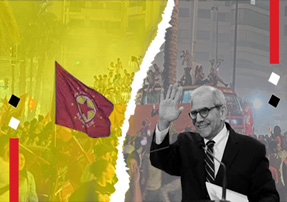
"Thank God who liberated us," was a phrase uttered by an elderly woman from Southern Lebanon in 2000 following the Israeli army’s withdrawal from the South and Western Bekaa. This statement, which reflected the Southern accent of the woman, gained widespread popularity and was even used mockingly at times. Another woman, while expressing her anger toward Israel, mistakenly said, "May God bring you down, Israel, and bring down your enemies," again in the same Southern accent. This phrase also became a common saying, used by Southerners and Lebanese in general to express frustration with various situations.
Abu Hassan owns a household goods store in a village in Bint Jbeil district, outside the border strip. During this time of year, "business is usually booming," he says. Normally, they eagerly await the summer season, as expatriates and tourists come from Beirut, buying air conditioners, fans, kitchen appliances, chairs, tables, antiques and other items. However, this year is completely different; business has nearly come to a standstill. People are "barely making ends meet," and the crisis has affected everyone. The locals have lost much of their income due to the collapse of the summer season, and the internally displaced have also lost their livelihoods. The aid they receive from partisan sources barely covers their daily needs.
Near Abu Hassan’s shop is a small café with a few tables, a coffee machine, and a fridge with refreshments. Young men in their twenties and thirties gather there daily to drink coffee, play cards, and backgammon, while a small TV on the wall is on Al-Mayadeen channel. The TV’s sound is so low that it’s hard to hear what the guests of the talk show are saying. None of the attendees really care anymore. Unlike the early days of the war, when everyone was eager to know what was happening and they awaited the news bulletins and political analyses that normally provide positive mood, boredom and indifference dominate nowadays. People no longer pay attention to what is being said on TV and rely solely on breaking news notifications on their phones to update them about airstrikes and artillery shelling.
Hassan, 34, says he comes to the café daily and spends hours there because he has nothing else to do. He tried finding work after being displaced from his village of Marun al-Ras, but without success. He is a construction worker, but as he points out, "all construction sites have stopped." His friends at the café nod in agreement.
"This war has changed our lives," Hassan adds. "We now dream of returning to our lives before displacement, with all its poverty and hardship. At least we were in our homes and felt safe. These are things only those who lose them can appreciate."
Since the first weeks of the war Hassan lives with his wife and two daughters in a small apartment outside the border strip, provided by a family residing in Beirut. In addition to the material losses his family has endured, Hassan now fears the psychological and mental impact on his daughters. His eldest, seven years old, has developed a real fear of loud noises. When they were still in Marun al-Ras, a shell landed near their home, and his daughter, who was holding a chocolate bar, became so terrified that she clenched the bar in her hand and couldn’t open her fist for hours. That same day, Hassan decided to leave his village, not wanting to risk further traumatizing his family.
His youngest daughter, only one and a half years old, is now terrified every time she hears the sound barrier being broken, leading her to cry for long periods. "How will we heal from all of this?" Hassan asks.
Tens of thousands of Southerners find themselves caught in a war that has been raging for over ten months between Hezbollah and Israel. A war is driven by regional and international calculations, over which they, as citizens, have no influence. Whether they support or oppose the war, their opinions make little difference, as the saying goes, "There is no opinion for those who are not heeded."
Southerners’ opinions about the war vary, despite the media aligned with Hezbollah trying to present a unified stance on their end. The war’s consequences have affected most Southerners, either directly or indirectly; and, as in any war, the level of suffering differs from one person to another, from one family to another. The residents of the border strip have undoubtedly paid the highest price, as most military activities and airstrikes have concentrated in this area of which the Israeli army withdrew in 2000. The area consists of around 40 villages stretching from Shebaa in the east to Naqoura in the west, and divided into three sectors: eastern, central, and western.
.jpg)
Near a shop in the square of a village that has received hundreds of displaced people, a group of men gather every evening waiting for the call to Maghreb prayer to go to the mosque. They pass the time drinking coffee and tea and telling a few jokes. They’ve recently grown tired of discussing politics, finding the topic dull and repetitive. They now only want one thing: "to return to their villages."
Their conversations, scattered and random, range from the weather to rising prices and the long hours of boredom. Sometimes, their discussions turn nostalgic as they reminisce about life before their displacement, talking about it with great longing as if it happened years ago.
The tone of their conversations has changed over time. In the early weeks of the war, the general feeling among the displaced was that the conflict would be short and limited, and they would soon return home. This belief was based on analyses and conclusions drawn from news websites and WhatsApp groups, growing in numbers over the past years and many of which are run by activists and influencers aligned with Hezbollah and Amal movement, therefore working according to the two parties’ guidelines. These groups constantly promote narratives of victory to create a sense of optimism among the Shia community, although these narratives are not necessarily accurate or realistic.
In the early stages of the conflict, people believed that the Israeli army could not fight on multiple fronts, that Israeli Prime Minister Benjamin Netanyahu’s government would collapse under public pressure, and that their priority would be to secure the Israeli hostages in Gaza. This, they believed, would allow the "Axis of Resistance" to declare a "clear victory" and capitalize on this success in countries where Iran’s influence is strong.
The initial optimism helped ease the burden of displacement for the Southern villagers, as they saw the situation as temporary and manageable, with damage being minimal and easily compensated. However, as the crisis dragged on month after month, and rumors of potential deals to end the nightmare repeatedly collapsed, people began to feel as if they were stuck in a vicious circle.
Abbas, 23, displaced from Aitaroun, was watching a video on his phone of young men celebrating on motorcycles in the Southern suburb of Beirut after Hezbollah’s Secretary-General Hassan Nasrallah's speech calling people to return home. Abbas sarcastically commented, "Aren't we supposed to return to our homes, or are we not included in that speech?" Another displaced man in his fifties replied, "Why are they celebrating in Beirut? Has the war ended? What a mockery!"
Abbas, his brothers and parents now live in the town of Srifa where they took refuge in the third week of the war. He notes that dozens of families from Aitaroun are now in Srifa, forming their own community, what he calls the "Aitaroun neighborhood in Srifa," complete with shops, a butcher, a cell phone store, and other small businesses creating a miniature market for the displaced. The presence of so many people from Aitaroun has even led some young men to jokingly remove the name of Srifa from a road sign and replace it with Aitaroun, causing some tension between the two groups.
Abbas says his family receives $200 a month from Hezbollah, just like all the displaced families from the border strip. "That amount barely covers one week," he explains. When asked if he feels grateful, Abbas replies, "Take me back to my village, and I'll give them $200 a month myself."
Abbas has tried to find work to support his family during their displacement, but job opportunities are scarce, and those looking for work are too numerous to count.
Before the war, Abbas worked with his parents in tobacco farming, a profession they inherited from their parents. "I don't know how it started," he says. "It feels like tobacco farming, with all its hard labor and the wait to get paid at the end of the year, is something that was forced upon us."
He adds, "We are forgotten people. We were forgotten before the liberation, and we remain forgotten afterward. Today, we pay the heaviest price. We’ve lost our homes, our crops, we’ve been displaced from our villages, and our land has been poisoned by phosphorous shells. No one cares about us."
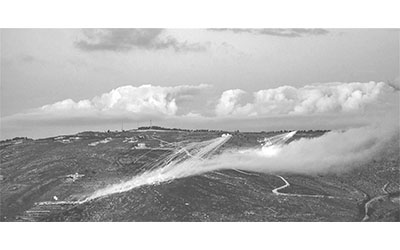
Abu Mustafa, a displaced man in his forties from Adaisseh, settled in Khirbet Silm. On the third day of the war, he lost his home; and days later, a shell hit his grocery store. Whenever a Hezbollah or Amal fighter falls in battle in the South, a temporary truce is arranged for some hours by UNIFIL to allow for funerals and burials. Abu Mustafa uses these truces to participate in the burials and then rush to his damaged store to salvage whatever goods he can carry.
The war has caused massive destruction, with hundreds of homes and businesses destroyed. The cost of reconstruction is likely to exceed the capacity of both the Lebanese government and Hezbollah. Unlike in 2006 when many Arab countries helped rebuild Lebanon after the July War, most of them now show little interest, viewing Lebanon as an integral part of the Iranian-led axis.
Displaced people today fear that promises of reconstruction may go unfulfilled. Slogans like "We will rebuild it better than it was" may no longer be realistic or achievable. At the same time, many signs have emerged recently suggesting that the war will be prolonged and that the displaced may need to adapt to life in their temporary villages and start looking for new sources of income.
Rabih, who works in a carpet and decoration store in Mais al-Jabal, a well-known hub for Southerners for trade and a market for home appliances and furniture, notes that the war coincided with the peak season for carpets. His employer had bought stock worth hundreds of thousands of dollars just days before the war broke out. Like many others, he left everything behind and fled the war.
Recently, dozens of trucks, escorted by the Lebanese army and UNIFIL, entered Mais al-Jabal and surrounding villages to remove large quantities of goods and household items from the area. Rabih says this made him anxious, as if they were being told they would never return to their village and should find another place to sell their goods.
Rabih is worried from another incident, the fact that one of Bint Jbeil’s educational institutes has opened a new branch in Safad Al-Battikh village to which the Bint Jbeil’s students were transferred. Other schools expanded their sections to accommodate larger numbers of students. These are signs, according to Rabih, to two scenarios, both bitter and hard. Either we face an open war destroying everything and turning our lives into a living hell, or the status quo would drag for long, which equals to a slow death draining our nerves and souls.
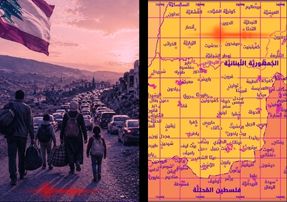
The approach of the new school year adds another layer of psychological pressure on displaced families. People don’t even know where they’ll be in a few weeks or months. Will they return to their villages, remain in their current locations, or face the harshest scenario and be displaced again if the broader war escalates? The Gaza model looms over them like a specter—waves of people carrying their belongings on their backs, displaced over and over again.
Umm Sami, a mother of four, displaced from Deir Siryan and settled near Nabatieh, says her children who attend a public school within the border strip, were out of school for over two months after the displacement before resuming their studies online at the beginning of this year. However, Umm Sami doesn’t believe in the effectiveness of remote learning, experienced by her children during the COVID-19 pandemic, with disastrous results as she says. "Today, the situation is even worse," she adds, pointing out that internet services are terrible, and their temporary home is too small for four students to follow online lessons and complete their daily homework. The aid provided by the Ministry of Education and Higher Education, such as internet cards and tablets, is insufficient.
Blowing smoke from her cigarette, Umm Sami adds, "We just want this nightmare to end. The price we’re paying is far too high. Young men in their prime are being hunted by planes and drones. At first, we were enthusiastic, thinking we would win as we always do. But the reality is different this time. It’s easy to see. We used to cheer when rockets were fired from Lebanon and when casualties fell on the other side. Today, we dread it because we know it means we’re in for a difficult night."
A report by the International Organization for Migration (IOM) earlier this year showed that more than 82,000 people had fled the border strip and settled in less dangerous areas. This number has continued to rise as the fighting intensifies and the scope of the conflict expands.
In conclusion, the prevailing mood in the South is one of sadness and frustration. You can now hear whispers questioning the wisdom of opening the Southern front and exposing the people to all they have endured thus far, especially as the Gaza strip has been destroyed and the Southern front’s activities have not alleviated the suffering of the Gazans. This is the reality in the South, while what appears on social media—calls for war, fighting, and achieving victory—is merely performative and does not reflect what’s happening on the ground.