Power, in all its forms, constitutes one of the most essential foundations of politics. Those involved in politics and its language often distinguish between the "power of logic" and the "logic of power," the latter being synonymous with violence. It is the excessive reliance on power as a primary and sometimes sole driver of political discourse and action. Consequently, the "logic of power" can become a political tool that reflects both the nature of a political project and a party's perception of itself and others. Naturally, the logic of power requires the presence of a "leader" capable of wielding it. Although a leader's personal qualifications play a crucial role in shaping his image among both supporters and opponents, these qualifications do not eliminate the need for continuous propaganda, which differs entirely from traditional leadership protocols. Propaganda plays a key role in constructing the "imagined persona of the leader."
In the Arab world, the leader's persona often plays the largest role in shaping a group or nation's political behavior. Arab politics remains deeply tied to the figure of the leader, with the merging of state and power concepts and the near-absence of the notion of institutional governance. As such, the leader's persona itself becomes a tool for advancing and sustaining a political project, as well as a means of persuasion for “the masses”.
Observers of Lebanon's current political situation may conclude that it still aligns with this understanding. Each party has its share of the logic of power and rhetoric of superiority over others, but the largest portion of this, both in discourse and practice, belongs to Hezbollah. For Hezbollah, the logic of power has become more synonymous with its identity than for others. This reality stems from both objective and subjective factors, the most important being its possession of a massive arsenal that makes it, willingly or not, view the world through the lens of its weaponry. The second factor is that Hezbollah is an ideological party that conflates, at least rhetorically, religion and politics, leading to an exclusionary stance towards others. Therefore, the presence of these two factors within Hezbollah, and its supporters in particular, makes it logical to see the party’s status as it is today.
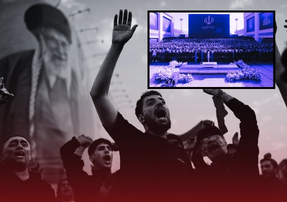
Sanctification, in technical terms, refers to the act of elevating someone beyond any fault or flaw. The year 2000 marked the beginning of the sanctification of Hezbollah's leader among its supporters. Before his assassination, the former Secretary-General, Abbas Al-Moussawi, was not regarded as a sacred figure, despite being one of the party's founders and its second Secretary-General. In contrast, there is little need for analysis to confirm that the current Secretary-General, Hassan Nasrallah is viewed by his supporters as a sacred figure. According to Dr. Daoud Faraj, a psychologist, “the sacred figure is the compass and path for those who sanctify them. Their public life revolves around this figure, who unites and ensures their cohesion, shaping their behavior and lives.” He compares this to a society of ants, where communication is not direct but occurs through the "queen," who serves as the central point for all.
Several factors have played an important role in creating this sanctity. In addition to Nasrallah’s personal capabilities, the massive media apparatus surrounding him, and the audience's predisposition to sanctify a figure who merges religion and politics; several external events have also contributed, such as the Israeli withdrawal from southern Lebanon in 2000, the death of Syrian President Hafez al-Assad in 2000, the Syrian withdrawal from Lebanon in 2005, the 2006 war, and other incidents.
This sanctity plays a key role in presenting and maintaining the leader’s persona. As Dr. Dawood Faraj notes, “maintaining the leader’s status requires portraying him as a grand figure who does what ordinary people cannot. The mystery surrounding the leader is crucial to this. The leader's persona, this grandiose persona, serves as a fundamental anchor in the unconscious relationship with the masses, which cannot function without this sanctity.”
One of the first manifestations of this sanctity is that criticism is equated with insult if the sacred figure is the subject of critique. The typical consequence of such criticism is a severe “punishment,” often involving violent beatings aimed at forcing the critic to retract their opinion and publicly apologize. When this method succeeds, the retraction and apology are referred to in Lebanese colloquialism as a "Sahsouh" (a slap on the head). To emphasize the effectiveness of the "Sahsouh” in persuasion, people, both supporters and opponents, began to differentiate between positions based on whether they occurred “before the Sahsouh” or “after the Sahsouh.” Despite the term's connotations of violence and moral degradation, its use in this text is solely for its intended meaning and implications.
.jpg)
Hezbollah's relationship with violence dates back to its formation in the 1980s, during the Lebanese Civil War. As a product of the war’s complexities, Hezbollah naturally played its part in both participating in combat and targeting public figures and intellectuals, particularly those from the Shia community, as well as common Shia people. Some elderly of Lebanon's Beqaa region recall that unveiled women were harassed by Hezbollah members in its early days. During the war, it was not unusual for Hezbollah, like other parties, to attack his opponents, especially in Shia dominated areas which the party sees as its vital sphere in a country marked by sectarian divisions, and in which sectarian parties try to hold grab of their own sect more than controlling the “regions” of other sects. While Hezbollah seeks to monopolize Shia representation in the government, even at the expense of the Amal Movement; and although these two parties share the sectarian representation of the Shia, they were never the sole representatives of the Shia community which naturally contains both supporters and opponents.
The "Sahsouh" has a relatively long history within the Shia community, becoming part of its collective culture. In addition to political intimidation of opponents, especially during elections, the party practices violence even against its own supporters when they momentarily stray from loyalty. The term "Sahsouh" specifically refers to the success of repression in changing the opinion of the oppressed. However, it should be noted that if not all victims of violence change their views, so it would be incorrect to describe their cases as “Sahsaha,” (the act of giving a Sahsouh), to use the colloquial derivative.
The phenomenon of the "Sahsouh" became widespread following the 2017 events of Hay al-Sellom in Beirut's Southern Suburb, when unauthorized markets were removed, and store owners protested by blaming Hezbollah. In an unprecedented event, some criticized and blamed, even insulted Hezbollah’s Secretary-General, Hassan Nasrallah, on media platforms. Reviewing the stores owners’ statements, one can realize that they were not speaking out of enmity towards Hezbollah but of complaint to a party supposed to safeguard the sect’s interests. Moreover, some of the objectors refused to curse. Most of those who spoke to the media addressed the Secretary-General as “revered (Samahat) Sayyed”. However, within days, these same individuals reappeared in the media, offering humiliated apologies to Nasrallah.
Similar incidents followed during the October 17, 2019 protests and afterward. The list of those who publicly apologized includes Ali Shams (Hay al-Sellom, 2017), Louay Shibli (Sidon, 2020), and Walid Mesheek (Ring Bridge, 2020). The most recent incident occurred in the Southern village of Ain Qana in 2023, where protests erupted over living conditions, with residents ‘denouncing” two MPs, Mohammad Raad and Hani Kobaissi.
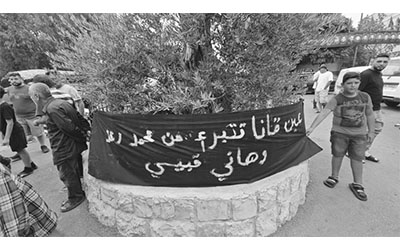
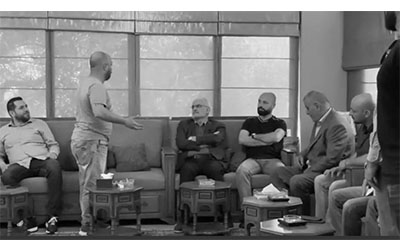
In contrast, many cases demonstrate that physical or moral violence of Hezbollah has not succeeded in silencing critics. Repression is not limited to political opponents and ordinary citizens who publicly oppose the “leadership”, but also extends to clerics who deviate from Hezbollah’s religious discourse. This was evident in August 2023 when the Supreme Islamic Shia Council issued a statement stripping 15 clerics of their religious status, including that at the Jaafari religious court, most notably Sheikh Yasser Audeh, who has faced, along with his children, systematic defamation and harassment since 2017. In addition, there were attacks against media figures. One example was the stopping of satire television show “Bass Mat Watan” for imitating the Secretary-General of Hezbollah. Another is what happened to photographer Hassan Shaaban in the Southern town of Beit Hanoun in 2022 for covering local objections on water shortage; he was beaten by some supporters of Hezbollah.
There is a long list of names and towns that faced the same fate, and it seems there will be more of them. The necessary question to ask here is about the implications of the “Sahsouh”, not only as a violent act, but as a political one on the one hand and a sort of culture in the community of Hezbollah on the other hand.
The transformation of a phenomenon into a culture implies the existence of a psychological foundation that allows for it. The widespread use of the term "Sahsouh" in society indicates that the social psyche is receptive to it. Dr. Dawood Faraj explains that “in childhood, boys who shave their heads often receive a playful ‘Sahsouh’ from their peers. The social meaning of the ‘Sahsouh’ extends to a symbolic level—when a person remains silent after a ‘Sahsouh,’ it signifies submission to social authority”. Most importantly, the "Sahsouh" carries connotations of inferiority. Faraj notes, “The person who receives a ‘Sahsouh’ is seen as disobedient and subordinate, lowering their head in submission to the hitter. This act of bowing the head is a form of obedience and signifies an inferior status in the eyes of others.” The more dangerous aspect of the issue is the sense of inferiority with which the person receiving a "Sahsouh" is viewed. Dr. Faraj adds: The one who receives a "Sahsouh" represents the disobedient and lower-ranking individual who does not lift his head in front of the one who strikes, as the "Sahsouh" occurs when the person lowers his head downward.
Even when said in jest, like "I gave him a Sahsouh," there is an element of disdain. From here, changing one's stance after receiving a "Sahsouh" is seen by people as submission and inferiority because, according to social norms, a "man" or a "real man" does not change his stance under pressure. Thus, the "Sahsouh" is a form of moral humiliation for the person in front of a society that perceives it in this way.
Additionally, the "Sahsouh" serves as a message and a live example for anyone considering voicing objections in society: "Anyone who wants to speak out should know what awaits him." This adds a deterrent dimension to the practice, serving to discipline others as well. Hence, the symbolic significance of the "Sahsouh," as a repressive tool, is particularly painful because it affects the moral aspect of the person receiving it.
The concept of the "Sahsouh" is tied to the idea of discipline or "punishment" that individuals grow up with, whether in school or even at home. In school, there is punishment and discipline for the unruly student, and one of the forms of punishment is beating. Thus, the "Sahsouh," as a form of beating, carries a disciplinary dimension. Dr. Dawood Faraj summarizes this process, explaining that the critic or insulter is seen as someone who is "disrespectful towards those above him, thus he is undisciplined, rejected, and out of line. Therefore, he must be disciplined." The "Sahsouh" then becomes a form of social discipline as well. The reasons that might warrant a "Sahsouh" are relatively many, but the most important by far is directly criticizing or blaming the Secretary-General, or insulting him. This, according to Dr. Faraj, is because "the leader is a taboo, and touching upon him is like touching the sacred. This personality, sanctified in every sense, gives the individual his moral value, and attacking him is a personal attack on the individual. Thus, the 'Sahsouh' can sometimes be initiated individually, but it wouldn't be repeated without the approval of the higher-ups. Therefore, it may start as an individual initiative followed by approval." On the party level, it relies on numbers to show its strength in economic, political, and military domains. Dr. Faraj likens this approach to a pack of hyenas "that rely on numbers to show strength—they do not attack prey unless they are in a group, unlike lions, for instance. This numerical display creates a form of intimidation, presenting themselves as a large and cohesive entity. This is their way of demonstrating power, even during festivals and in the exaggerated spending during charitable activities."
When examining this issue closely, it’s important to study Hezbollah’s community and its interaction with the "Sahsouh." Naturally, there are those among them who do not accept this reality. However, a significant percentage react to the "Sahsouh" with approval and celebration, or at least with acceptance. A quick tour of social media platforms shows that the "Sahsouh" is widely welcomed, not only by the party’s supporters but even by some members of the "elite," such as journalists. Here’s a sample of reactions, quoted verbatim without naming the individuals involved: “They gave you a few Sahsouhs , but this time a screw is coming your way.” “Someone should slap him either with a handshake or a Sahsouh.” “…Read history well and learn. This time it’s not just a Sahsouh, this time we’ll discipline you till Judgment Day.” “You forgot, oh Twitter clown, a neat Sahsouh, enjoy it.” “Blessed hands! You win the Sahsouh of the season.” “He ate a Sahsouh and apologized like a fool.” “Your turn is coming to eat a Sahsouh.” Additionally, many videos have circulated under the title "Before the Sahsouh... After the Sahsouh."
It is noticeable that the celebration and acceptance of the "Sahsouh" is often preceded by accusations, either direct or indirect, of treason or betrayal as a justification for this punishment or discipline. This is the logical result of a dangerous equation prevalent in much of the party’s environment, which can be summarized as: "You’re either with us or you’re a traitor/agent." This equation itself is a logical consequence of the blending of religion and politics in this environment. Political issues founded on religious, or generally ideological, bases inevitably lead to such exclusionary equations by their nature, regardless of the party's intent. Most parties of political Islam, according to the views of Palestinian Thinker Dr. Adnan Ibrahim, as expressed in his lectures, have "an absolute sense of righteousness" and suffer from the "world’s master" complex. In the same sense, the party’s environment sees itself as having the right to judge and discipline others—not from a position of oppression but from the perspective that they alone are the custodians of the "just cause" built on metaphysical grounds, whereas it should be a political cause based on tangible and observable realities. Therefore, the cancellation of the other is a result of this "righteousness complex," as it allows its bearer not only to play the role of God’s envoy but to assume God’s role in judging people's external actions and internal thoughts alike.
Conversely, Adnan Ibrahim discusses the issue of political Islam parties as entities that focus on stripping their members of critical thinking. The danger of critical thinking increases for parties that operate with ambiguity and secrecy. Therefore, the use of violence and systematic repression enhances these parties’ control over people; as critical thinking, when becoming a collective practice, necessarily leads to the group's rebellion against authority.
The use of the term "Sahsouh" is no longer limited to Hezbollah’s environment. Some opponents now use the term either in mockery or as a form of retaliation. Dr. Dawood Faraj explains that "the Sahsouh has become a byword because it is widespread and blatant, and is a source of mockery and sarcasm among many who object to the idea. Ridiculing the idea means rejecting it.
Naturally, the intention of this article is not to legitimize insults or justify the "Sahsouh" as a practice or theory. In other words, insults are just as unacceptable as the "Sahsouh" as a customary response to insults or, even more so, as a response to criticism. However, it seems that when the "Sahsouh" turns into a widespread culture, the means of escaping it extend beyond legal channels to a wide network of cultural, psychological, and scientific methods that contribute to addressing Lebanon’s long-standing issue: the dilemma of the self and the other.