Experts in human development studies almost unanimously agree that childhood is the most critical and sensitive stage of human life. It is during this period that both conscious and unconscious awareness are formed. A widely accepted theory among human behavior researchers is summarized by the English philosopher Bertrand Russell, who stated, "People are not born foolish, but ignorant, and then they are made foolish." Regardless of how people are born as or what they become, the central issue is the existence of a process that shapes the mindset determining an individual’s behavior across various aspects of life, especially in the political arena.
In the world of politics, ideological organizations—religious or otherwise—deliberately build an ideologically-driven popular base that is resistant to logic as well as emotions. What distinguishes ideological organizations from non-ideological ones is that the former prefer "cultivating" their base rather than "attracting" it. It is easier and more secure to control a “cultivated” audience on the long-term than to manage an “attracted” or “polarized” one. This explains why these organizations focus on "cultivating" children and reshaping them in a way that serves the political agenda of the "cultivating" organization.
Following this pattern, Hezbollah has been shaping new generations of supporters in three primary spaces—schools, scouts, mosques and scholars (hawzat, plural of hawza), alongside the broader geographic area under its control. Despite the distinctiveness each of these spaces is presumed to have, they work in tandem to mold the new generations into the image Hezbollah desires.
Since 1993, Hezbollah has established a network of private schools under the name "Al-Mahdi Schools," affiliated with the Islamic Institution for Education and Teaching. Today, Al-Mahdi Schools comprise 18 branches in Lebanon eight in the south, four in the Bekaa, and three in Beirut, along with a smaller one in the Iranian city of Qom for Lebanese and Arab communities. According to the official website, the average area of these school branches in Lebanon is around 10,886 square meters, with an average building space of 5,458 square meters. The capacity of 13 of these branches alone is approximately 18,208 students, which represents about 44% of the total number of students in private non-free Shia schools in 2019-2020, estimated at 41,541 students according to the figures of “The International Information Company” specialized in producing statistics.
.jpg)
It is important to note that Hezbollah tightly controls these very private schools, rejecting any form of oversight by official Shia authorities or the Lebanese government. A visit to the official website of these schools gives a glimpse of the environment in which the "students" are raised. This environment is shaped by two primary elements: the nature of the "activities" the school organizes for students and the writings that some of them contribute "in their own words" on the website.
When reviewing the main activities held for the students at Al-Mahdi Schools, one will find it extremely difficult to believe they are occurring in Lebanon; even the recreational activities have a partisan and religious nature exclusive to Hezbollah and the Iranian axis. Here are some examples of these “activities”:
- An event for preschoolers (under six years old) to commemorate the "leader martyrs," featuring a story about the occasion, a cartoon screening of The Child and the Occupier, and patriotic chants and slogans.
- A religious activity marking the end of the school year for first-grade students (6–10 years old) concluded with revolutionary and patriotic chants such as “Peace be upon you O Mahdi”.
- During the "Ten Days of Dawn" and "Day of the Leader," commemorating Khomeini's return to Iran in 1979, a ceremony was held for all educational levels (6-18 years old) in which the website described the event as follows:
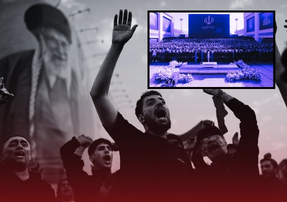
- "The hearts united in love for their leader (...) and the voices of the crowd rose and echoed, declaring love and loyalty to the revered leader, Sayyid Khamenei. They proudly and confidently proclaimed, 'We are the lovers of the Guardianship,' and pledged their allegiance and loyalty, committing to follow their leader on his path in peace and war [until] the appearance of [the Mahdi]."
On the occasion of Khomeini’s death, an event was held at one of the Al-Mahdi high schools to introduce him. It concluded with the recitation of a segment from the song "Khomeini, We Are Loyal to You," accompanied by raising his pictures. Additionally, other activities were held, such as "Mujahid Suhoor," mourning sessions, latm (ritual chest-beating in Ashoura), the commemoration of "Martyrs' Day," honoring the "Mothers of Martyrs" on Mother's Day, and collaborations with the "Association for Reviving Resistant Heritage." These "activities" blur the lines between these schools and political party centers.
These activities, targeting age groups from 4 to 18 years old, aim to present a future mental image that the child is expected to strive toward. Regarding the impact of this environment on the psychological development of children, Dr. Dawood Faraj, a psychologist, states that these "activities" lead to what is called in educational philosophy the "process of personality standardization." He adds that a child’s psychological growth, between the ages of 6 and 11, is based on the mechanism of identification—boys identify with their fathers, and girls with their mothers. Through these "activities," the "leader/guardian" is presented as a substitute for the father figure, serving as a model to emulate. Thus, the “leader” becomes an extension of the father, and the emotions the child associates with the father are transferred to the "leader," who then becomes the alternative father figure to whom the child submits with absolute obedience (allegiance and loyalty). These "activities," according to Faraj, "pull the child toward this direction so that he adopts it when he grows up," transforming the relationship between the targeted child and the "leader" into a psychological one. Consequently, affiliation with the Iranian axis, of which Hezbollah is a key pillar, becomes essential for the child, who sees the ideology he was raised on as a dream he wants to achieve.
When considering the impact of these "activities" on the psychological formation of the child, two key concepts can be observed, through which Hezbollah shapes the self-image of the new generation and their perception of others:
- Belonging: Hezbollah works to diminish national identity by lowering it beneath religious/partisan identity. Through numerous activities, children are made to care about issues irrelevant to all Lebanese, many of which contradict the essence of national education. Examples include commemorating Khomeini’s return to Iran or his death, pledging allegiance to Khamenei, and other slogans that make the children feel that these occasions define their existence and represent their identity more than Lebanese Independence Day, for instance. Regarding the effect on national identity, Dr. Mona Fayyad, a social psychologist, says that children, during their formative years, are heavily influenced by everything they learn during this period, especially if the teacher/educator is seen as an ideal figure. She adds that national identity is also a form of training, achieved through specific mechanisms, the creation of foundational myths, and reference models that children later recall when making decisions. The influence of these "activities" is further amplified when they envelop the children completely in both time and space, making these models the only available option.
The most concerning aspect is that Al-MahdiSchools practice a disguised "Persianization" policy, attempting to implement the Iranian educational model. This is evident in a book entitled Theoretical Foundations for Structural Transformation in the Official and Public Education System in the Islamic Republic of Iran, a vision approved by the Supreme Council for Education and Teaching in Mashhad, Iran, in 2010. Dr. Hussein Youssef, the director-general of the Islamic Institution for Education and Teaching, states that this book represented a "turning point in addressing the issue of educational authenticity" in these schools. If we consider that one of the theoretical foundations on which this vision is based is the "Islamic Revolution discourse," which revolves around the ideas of Khomeini, Khamenei, and other prominent figures of the Islamic Revolution, we can conclude that adopting this as a basis for the educational vision of Al-MahdiSchools represents the cultural and educational extension, so to speak, of the "exporting the revolution" slogan that Khomeini raised in 1979. Iran, through Hezbollah, uses religion, culture, and education as tools to control and influence the generations produced by these schools. In this light, we can understand the official Iranian presence at the celebrations and activities held at these schools, especially the political presence at cultural activities that should ideally be attended by the Iranian cultural attaché, not the political adviser to the Iranian ambassador. We can also reconsider the aim of teaching Persian as a second foreign language in the curricula of Al-MahdiSchools.
- Imagination: The shaping of a child’s imagination in these schools follows the duality of "hero-soldier." The child’s concept of a "hero" assumes that to be a hero, one must be either a "martyr" or a "mujahid" within the Iranian axis. As a proof on the connection between heroism and affiliation with Iran, the ninth central competition for the Persian language held by Al-Mahdi Schools was named after "Martyr Qasem Soleimani." Dr. Mona Fayyad emphasizes this point in her analysis of a photo featuring military leaders in the Iranian axis, such as Imad Mughniyeh and Qasem Soleimani, along with the phrase "May your terror continue." Fayyad notes that the image conveys the message: "We have terrifying heroes, and these are our heroes." According to Dr. Dawood Faraj, the presence of these symbols associated with the martyr/mujahid figure helps shape the child’s psychological image of the hero or ideal figure. This process generates a subconscious desire and motivation in the child to emulate this image. Since this is the only image available to the child, his identification with it becomes more automatic.
The second cornerstone could be called "militarization of the imagination." In addition to school activities with a military or "jihadist" dimension (Martyrs’ Day, Mujahid Suhoor, Leader Martyrs), Hezbollah’s Mahdi magazine and Ilaab Qawim (Play Resist) website reinforce violence and weaponry as part of the child’s imagination, making them integral elements. Examples of these "games" include:
- Helping "Arnoub" (popular nickname of a toy rabbit) cross a minefield;
Coloring equipment "needed by a mokawem (resistant fighter) in battle";
- Stickers shaped like rifles and hand grenades for children to "engage" with, as described by the magazine’s content.
As for the games on the website, they are "a series of games through which you crush the Zionist enemy and remove it from existence... with the hands of the mujahideen of the Islamic Resistance." Examples of these games include:
- The "Liberation Games Series": depicting Hezbollah’s operations between 1982 and 2000;
- "The Enemy in the Crosshairs": affirming that Lebanon is a graveyard for Zionist invaders;
- "The Sacred Defense Game": representing Hezbollah’s fight against the "Takfiri (Blasphemy) project and the American-Zionist agenda."
It’s worth noting that the title "Sacred Defense" is Iran’s term for its war with Iraq (1980–1988). Hezbollah has thus created a game that mirrors every major milestone of the Iranian project in the region. Notably, Hezbollah’s approach to these violent games is not unprecedented; the American company Activision created a version of the Call of Duty series that simulates the invasion of Iraq and other U.S. military operations, where the player acts as an American soldier.
The danger of these games, as noted by children's and youth literature author Fatima Sharafeddine, lies in their deep-rooted impact, "making weapons and violence a part of the child’s imagination and daily life." Dr. Mona Fayyad compares this situation to a "Spartan society," where the state intensively trains children militarily, turning them into soldiers with absolute obedience to the "leader." Similarly, as described by Lokman Slim, the threat of these games lies in the fact that "a party that infiltrates children’s games, enters bedrooms, and reaches into cradles has become a greater danger than we can imagine."
These games also connect violence and weapons to real-life entities like the "Axis of Resistance," addressing the question often raised about such games: violent games are widespread, so why does Hezbollah create its own violent games based on its political project?
Hezbollah's Community: It's worth noting that Al-Mahdi Schools are not open to all Hezbollah members, but rather to the privileged and well-off among them. Many supporters and full-time members of Hezbollah send their children to public schools or private schools with lower tuition fees compared to “Al-Mahdi”. This suggests that Hezbollah is trying to build a self-contained society, not just within Lebanese society, but also within the Shia community itself, with Al-Mahdi and Al-Mustafa schools reserved for Hezbollah's “elite” and "nobles."
However, the environment in other schools within Hezbollah-controlled areas is not much different from that of “Al-Mahdi” in terms of prioritizing religious and partisan commitment over national or even academic commitment. For instance, a private school in the Hay al-Sellom neighbor Ten Days of Dawn hood held a morning session in its courtyard in 2009, dividing the students into two groups: those wearing black sat in the front, while those in school uniforms were behind them. This reinforced to students that their religious commitment, represented by the black clothing, was more important than their school commitment, symbolized by the uniform.
The students in their own words: Based on the above, it becomes somewhat expected that a tenth-grade female student (around 15 years old) would address Hassan Nasrallah as "The Guardian of Blood," and that a male student would write "in blood" about how his life has "changed course," without realizing that his 15-year life hasn’t fully unfolded yet to undergo a change in course! It’s also natural for a high school female student (under 18 years old) to feel "guilt" and ask for a "path to repentance;" and for eighth- and ninth-graders (under 15 years old) to feel "the fire of anger filling our hearts" over the plight of Yemenis during the "Operation Decisive Storm" against the Houthis. Questions naturally arise: Since when did children become so politically engaged to the point where they "angrily" react to such matters? How does a child, judging by his handwriting, not older than ninth grade, come to believe that Hassan Nasrallah is his protector? What makes a child’s wish to become "one of your heroic mujahideen" (referring to Nasrallah)? Why does another child sign off a letter to Nasrallah as "your student and mujahid"? Or write that he studies today "so that we can achieve victory in the future (...) and I ask God for martyrdom"? Another child promises that they are "ready and prepared for any request (...) we are with you, we are not small, but big, very big"?
In light of these writings, it’s essential to reconsider Nasrallah’s statement: "We are betting on the generations being raised in Al-Mahdi Schools."
Al-Mahdi Scouts began their activities in 1985 before getting official recognition in 1992. Before the year 2000, Hezbollah established a scout troop in every village from which the Israeli army withdrew. Today, the scouts are divided into five regions: Beirut, Jabal Amel I, Jabal Amel II, Bekaa, North, and Mount Lebanon. According to the General Commissioner, Sheikh Nazih Fayyad, the number of members by 2022 had reached 75,000, up from 1,600 in 1992. Fayyad adds that 6,000 leaders, males and females, all under 22 years old, work on recruiting youth up to the age of 17 into the scouts, which aims to create a virtual platform for direct interaction with targeted children under 14 years old.
.jpg)
Observing the scouting activities, slogans, and the names of the scouting cities, Al-Mahdi Scouts can be considered, as Dr. Mona Fayyad describes, an extension of the ideological framing and indoctrination process, targeting children during their "free time."
The most noticeable element is the strong physical and symbolic Iranian presence in scouting activities and cities. During major religious events like Ashura, the scouts organize activities and marches across large parts of Lebanon's geography where Shia Hezbollah supporters are present. For example, in the Mount Lebanon region, 9,618 "lovers of Hussein" participated in commemorating one of the Ashura nights, the most important event for the scouts. A report on the official Scouts website reveals the "achievements" of the Ashura program for the youth, Misbah al-Huda (Lantern of Guidance), across Lebanon as follows: the daily average attendance at these gatherings reached 49,878, with an average of 757 gatherings per day; and the daily participation rate in Ashura activities, which averaged 158 activities per day, was approximately 12,423 participants.
Ashura Gatherings play a significant role in attracting the youth, as stated explicitly by the Scouts in their report: "Many young people were attracted through this commemoration, and the trust of people and families in the Imam al-Mahdi Scouts Association (AJ) was strengthened, which offers all its resources for the optimal commemoration of this event." Dr. Dawood Faraj, analyzing the emotional environment of the Ashura rituals and its impact on recruitment, explains that a child, as a social being, is greatly influenced by the social environment around them. When a child sees the "group," especially peers of the same age, moving in a particular direction, they desire to belong to it and avoid isolation. In Faraj’s words, "The child seeks to preserve their social identity by remaining part of the group." This explains the significance of the term "our group," used by Hezbollah supporters when referring to themselves.
.jpg)
As for the processions in Hezbollah-controlled areas, such as the Southern Suburb of Beirut, they are led by pictures of Khomeini and Khamenei. The symbolism of these images is the same as that found in Hezbollah schools, carrying the same meanings of "loyalty and allegiance" that are also reflected in the names of scouting cities, like "Imam Khomeini Youth Scout City." Unlike the schools, however, the presence of the Iranian Revolutionary Guard Corps is clearly visible in the work of the Scouts through one of their magazines, Tasnim, named after an Iranian news agency owned by the IRGC.
Mosques and Husseiniyas (Shia religious centers) fill Hezbollah's geographical areas, operating according to the following formula: their presence indicates Hezbollah's presence, and their absence does not necessarily mean Hezbollah's absence. The religious role of Husseiniyas is secondary compared to their role in preparing and mobilizing Hezbollah supporters, particularly children and youth. Many of them also serve as scouting centers for the Al-Mahdi Scouts, especially in the Southern Suburb, where some activities and "sessions" take place in Husseiniyas or in rooms attached to mosques designated for scout activities. This is not limited to Husseiniyas affiliated with Hezbollah but extends to some related to the institutions of the late scholar Muhammad Hussein Fadlallah, which are now controlled by Hezbollah. For instance, one of the most famous Husseiniyas where Fadlallah used to lead prayers - despite being run today by his nephews or from his religious office - is practically under Hezbollah’s control an Ten Days of Dawn d hosting party and scout sessions.
The role of mosques and Husseiniyas completes the process of "shaping" the child's character. The targeted group in these places are children who have reached puberty, or the age of religious accountability, around 14-15 years old. At this stage, according to Dr. Dawood Faraj, the competition with parental authority begins, and a sense of rebellion against stereotypical images emerges as children transition from the concrete to the abstract. Faraj continues, stating that to prevent children from rejecting the stereotypical image imposed by Hezbollah, the "leader" is elevated to a sacred level and associated with a direct relationship with God. This is achieved through the idea of the awaited Mahdi, which Hezbollah exploits; the Iranian guide/Wali Al-Faquih (the supreme leader) to whom the child pledged allegiance in schools and scouts is the "deputy of Imam Mahdi" and is said to meet with him; Iran is portrayed as a state preparing for the "appearance of the Imam"; and Hezbollah members, along with all those aligned with the Iranian axis, are "soldiers of the Mahdi." Moreover, Nasrallah is described as one who "sees with God's eye." Such sacred propaganda, either spread by Hezbollah or created by its followers, leads Hezbollah supporters to believe not only that they strive to be "supporters of the Imam," but that they are indeed true supporters in reality. According to Faraj, this reinforces the stereotypical image and ensures its continuity among teenagers, many of whom, without the idea of the awaited Mahdi, would have abandoned this stereotype due to the natural psychological transformations that accompany adolescence. Hezbollah thus raises its supporters on the sanctity and infallibility of leadership, ensuring that the notion of accountability, or even questioning, is entirely absent from the mindset of "its group” of Jamaaa.
Dr. Mona Fayyad adds that the frequent religious occasions and associated rituals create a system that controls the child’s life, constantly exposing them to these models.
In addition to the three aforementioned spaces, there is a fourth: the community in which the child lives. Here, geography does not refer to the land itself, but rather what lies upon it. The most prominent feature of Hezbollah’s geography is the overwhelming number of images of Hezbollah leaders and figures from the Iranian axis, defining Hezbollah’s geopolitical sphere with the following equation: Hezbollah's vital zone begins at the first image and ends at the last.
Two aspects of these images warrant study: the first is the messages conveyed by the images and the praise or sanctification that accompanies them (e.g., "Hussein of this era," "If you crossed the sea, we would cross it with you"); and the second is the psychological impact these images have on the child’s development. Dr. Dawood Faraj explains that the images spread across homes and streets alike reinforce the primary stereotype, allowing it to grow further in the child's subconscious and imagination by providing an environment conducive to this stereotype. On the other hand, reaching the child can only be achieved by first reaching the parents. Thus, the presence of these images in homes and streets will make the child feel secure and sense their parents’ approval of the stereotypical image and their identification with it.
In conclusion, Hezbollah has created new generations of supporters through a tripartite process (family, school, community), with each space complementing the other to produce followers who embody the desired image. Or, Hezbollah bargains with them in a trade-off: their social identity and inclusion in the "group" in exchange for adopting the image Hezbollah wants. In light of this ongoing reality, the question remains about the "endgame" of Hezbollah's upbringing of children, especially after the potential decline or collapse of Iran's project in the region.