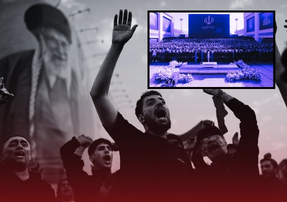
Despite the lack of legal and official authorization for Hezbollah—since forming political parties or associations within the Islamic Republic framework is considered theologically a "Western heresy" and un-Islamic—its political wing began, even before the end of the Lebanese Civil War, obtaining permits from the Lebanese Ministry of Interior for some of its associations under the guise of "cultural organizations." These associations later expanded beyond their original framework, using religious care for shrines and complexes to serve political purposes and mobilize the masses. As a result, Hezbollah-affiliated associations became active in managing religious sites, fostering both religious tourism and visits, in cooperation with Lebanese state institutions, including ministries and public administrations.
In this context, several religious associations tied to "Hezbollah’s Ummah" have emerged. Their overt goal is to care for religious shrines and complexes, but their underlying mission is “preaching” and to exploit “religious commitment” to recruit young fighters motivated by sectarian loyalty and religious indoctrination. Below are details of two prominent associations operating freely in this regard.
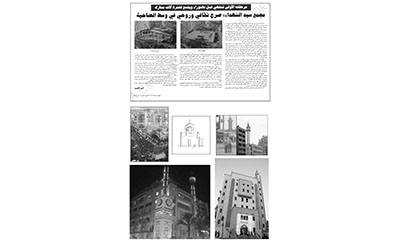
Before the official establishment of this association, Hezbollah had already constructed dozens of mosques and Husseiniyas (Shiite congregation halls) across various Lebanese regions, managing them through special committees. However, during Sheikh Abdul Amir Qabalan's tenure as President of the Supreme Islamic Shiite Council, Hezbollah formalized its work in this area by founding the Al-Baqiyat Al-Salihat Association in 2005. This association was tasked with managing its mosques, Husseiniyas, and religious complexes which typically include a mosque, a Husseiniya, and additional facilities like halls. It now oversees dozens of such sites across Lebanon, including in the Southern Suburb of Beirut where it manages several prominent complexes, such as:
- Sayyid al-Shuhada (Burj al-Barajneh, Al-Ruwais neighborhood)
- Al-Qa'im and Al-Sajjad (Harat Hreik)
- Sayyida Zainab (Bir al-Abed)
- Al-Askari and Al-Mujtaba (Al-Hadath)
- Al-Jawad (Al-Mreijeh)
- Sayyid al-Awsiya (Burj al-Barajneh)
- Al-Khomeini (Tahwitat al-Ghadir)
- Sahib al-Asr wa al-Zaman (Al-Laylaki)
- Al-Baqir (University neighborhood, Al-Hadath)
- Al-Kazim (Hayy Madi, Al-Shiyah)
- Amir al-Mu'minin (Hajjaj Street, Al-Ghobeiry)
- Al-Sadiq (Choueifat)
In Beirut, the association manages complexes like: - Khatam al-Anbiya (Nuweiri)
- Al al-Bayt (Jnah)
- Sayyida Khadija (Hayy al-Leja)
Additionally, it manages Al-Mustafa in Jiyeh and Al-Rasul al-Akram in Bshamoun.
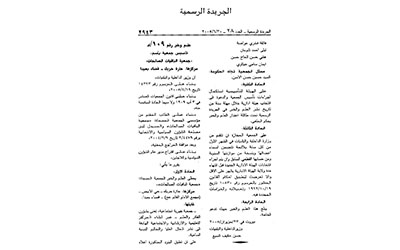
Back to the details of its licensing, the association obtained official approval under the "A'lam wa Khabar" decree dated June 30, 2005. The association's address was registered in Haret Hreik, Al-Abyad neighborhood, (Imam Al-Qa'im Complex). According to the decree, its purpose is to operate as a charitable, social association concerned with intellectual and educational matters through the establishment of educational, guidance, and social centers aimed at promoting high ideals and noble religious teachings. These activities are to be carried out in accordance with applicable laws and regulations and with the approval of the relevant authorities.
The founding members of the association include: Qassem Mahmoud Aliq, Sayyid Faisal Abbas Shukr, Ali Khalil Shari, MP Mohammed Ahmed Barjawi, Sultan Khalifa Asaad, Sheikh Akram Ahmed Barakat, with Ali Khalil Shari serving as the association's representative to the government.
As clearly stated above, the licensing of the association has not granted it the right to own and build mosques, religious facilities and compounds or to run them. However, it has established these facilities under the pretext of culture and of them being educational centers.
After the Israeli withdrawal from Southern Lebanon in 2000, Hezbollah took control of the shrines and religious sites in the region, having already managed similar sites in areas where its influence was strong, such as Baalbek-Hermel and West Beqaa. In 2011, Hezbollah formed the Qabas Association to unofficially oversee Shiite shrines across Lebanon. By 2013, the association obtained official recognition from the Lebanese Ministry of Interior.
The association presents itself as a guardian of the Shiite heritage, collaborating with Lebanon's Ministries of Tourism and Culture, as well as other local and official entities, to promote religious tourism and raising awareness about religious sites associated with Shiite Imams, Prophets, and other key figures. The association has many print and online publications about religious shrines in Lebanon. Qabas has been instrumental in promoting religious tourism in Lebanon, working closely with the Lebanese Ministry of Tourism to include Shiite shrines in official publications.
However, upon reviewing the license granted to "Qabas," it stated that its objective is to preserve the architectural heritage and historical legacy of prophets, imams, and notable figures of Twelver Shia Islam in Lebanon, across material, moral, and intellectual fields through the following means:
- Conducting specialized historical and technical research and investigations into their lives, sites, and legacies, and supporting university studies and research in these areas.
- Promoting and encouraging religious and cultural tourism in collaboration with the ministries of tourism and culture and other relevant civil and official entities.
- Publishing print and digital materials to introduce religious sites, prophets, imams, and Twelver Shia figures in Lebanon, thereby strengthening the connection between the past and the present, and enriching national archives and public libraries.
- Collaborating with similar associations and institutions, both locally and internationally, and signing cooperation protocols in shared fields.
- Organizing conferences, exhibitions, and events to promote the association’s goals.
- Contributing to the restoration and maintenance of religious monuments and sites.
In 2018, certain amendments were made to the license, maintaining the original clauses but adding several points. For example, an addition to the first article included “providing financial assistance to university students specializing in these areas and supporting related academic studies and research, as well as contributing to the establishment of public libraries.” Furthermore, in the sixth article, the restoration of religious monuments was expanded to include “developing the social environment surrounding these sites through cooperation with relevant ministries, public administrations, and official institutions.” A seventh article was also added, stipulating the organization of "rapid vocational training courses for professions needed in the job market."
Within a few years, the association shifted its nature of work to include financial activities, which naturally came from its management of funds related to religious sites. However, despite these changes, the core text, even with its amendments, did not grant the association direct authority or supervision over the management, restoration, or expansion of these Islamic or Shia religious sites. Instead, the text specified that the association's role was limited to contributing to these efforts rather than exclusively managing them.
Ultimately, the association managed to wrest control from the Higher Shia Islamic Council over a significant portion of the religious endowment, especially given that this endowment generates substantial financial returns. In addition to the land associated with these religious sites, which is managed by a single association, there are also the substantial donations from wealthy Shia individuals to these religious sites and shrines, as well as the money of daily offerings, vows and charitable contributions collected in donation boxes at these religious landmarks. Despite all of this, the Higher Shia Islamic Council did not take any action to reclaim its oversight over these sites. The only justification that the association has offered for its activities is that the council neglected these sites, thus it was only natural for them to step in and preserve this heritage. What is also striking is that the association has become the exclusive representative of these religious sites in dealings with Lebanese official entities and has gained considerable influence in this regard.
Through its operations and licensing, the association managed to oversee a large number of shrines and religious sites across various Lebanese regions, with the estimated number reaching approximately 150 shrines and sites. Here are a few examples:
Prophets' Shrines:
- Yunus in Jieh;
- In Southern Lebanon: Khidr in Sarafand and Najjarieh (two sites);
- Sari in Adloun;
- Imran in Qleileh;
- Simon the Zealot in Shema’a;
- Yahya in Haret Saida and Hannaweiyeh (two sites);
- Joshua in Reihan;
- Sajd in Sojod;
- Salim in Arabsalim;
- Seth in Jibshit;
- Jacob in Kfour - Nabatieh;
- Aaron in Khartoum;
- Yathir in Yathir...
Shrines of Saints in the South:
- Benjamin in Mhaybib;
- Abu Dhar al-Ghifari in Sarafand;
- Ansari in Ansariyeh;
- Qasim in Qasmiyeh;
- Mashuq in Burj al-Shamali;
- Mansouri in Mansouri;
- Siddiq in Siddiqin;
- Atha in Haddatha;
- Simon the Righteous in Tebnine;
- Muhammad Shah al-Khorasani in Upper Nabatieh...
Shrines of mainly prophets in Bekaa and Baalbek region:
- Noah in Kark Nouah;
- Seth in Nabi Shit;
- Saleh and Asbat in Brital;
- Ham in Ham;
- Ayla in Nabi Ayla;
- Khidr in Kfar Debash;
- Sam in Shmustar;
- Ishmael in Tariyah;
- Rashada in Nabi Rashada;
- Joseph in Kfardan;
- Solomon and Issa in Younine;
- Joseph and Joshua in Shaath;
- Othman in Nabi Othman;
- Joseph in Hermel;
- Moses in Tell;
- Anas in Taliya...
Shrines of righteous saints in Bekaa and Baalbek-Hermel:
- Sayyida Khawla in Baalbek;
- Imam Hussein in Ras al-Ain;
- Safiya, daughter of Hussein, in Hosh Tal Safiya;
- Gabriel in Hermel;
- Ali al-Zuhri in Kark Noah;
- Qasim in Ayn;
- Muhammad al-Qasim in Upper Taminin;
- Sadiq and Awsaja bint Muslim and Ataf in Boudai;
- Nujum in Tariyah;
- al-Ajami in Kfar Debash.