.jpg)
At the beginning of last March, shortly after midnight, people across southern Lebanon and the rest of the country woke to the news that six rockets had been launched from Lebanese territory toward northern Israel. At first, many assumed the rockets were from an unknown source, or perhaps launched by a Palestinian faction. The surprise came when Hezbollah officially announced responsibility for the attack, prompting residents across various regions—particularly in the South and Beirut’s southern suburbs—to flee in confusion, carrying whatever belongings they could manage in different directions, trapped for hours in suffocating traffic jams. Many left on foot, carrying only essential belongings on their backs. Others, unable to find immediate shelter on that dark night, slept on sidewalks. Large numbers also headed toward places they considered safer, especially along Beirut’s seafront promenades, waiting for daybreak.
Thus began a new round of open war between Hezbollah and Israel, after the party declared it had launched the confrontation in retaliation for its Supreme Leader, Ali Khamenei, whom Israel had assassinated several days earlier on February 28, at the outset of the war on Iran. The move also came in response to the reality Israel had imposed over approximately fifteen months following the end of the previous “support war” for Gaza.
During this war, Israel targeted various areas across Lebanon, including Beirut and its southern suburbs. Its deadliest day came on April 8, in what became known as “Black Wednesday,” which claimed the lives of around 350 people after fifty Israeli aircraft launched nearly one hundred airstrikes within the span of a few minutes on Beirut, the southern suburbs, and other scattered regions of Lebanon. Some of the strikes hit residential neighborhoods during peak hours, including areas previously considered relatively safe, such as parts of Beirut and Mount Lebanon.
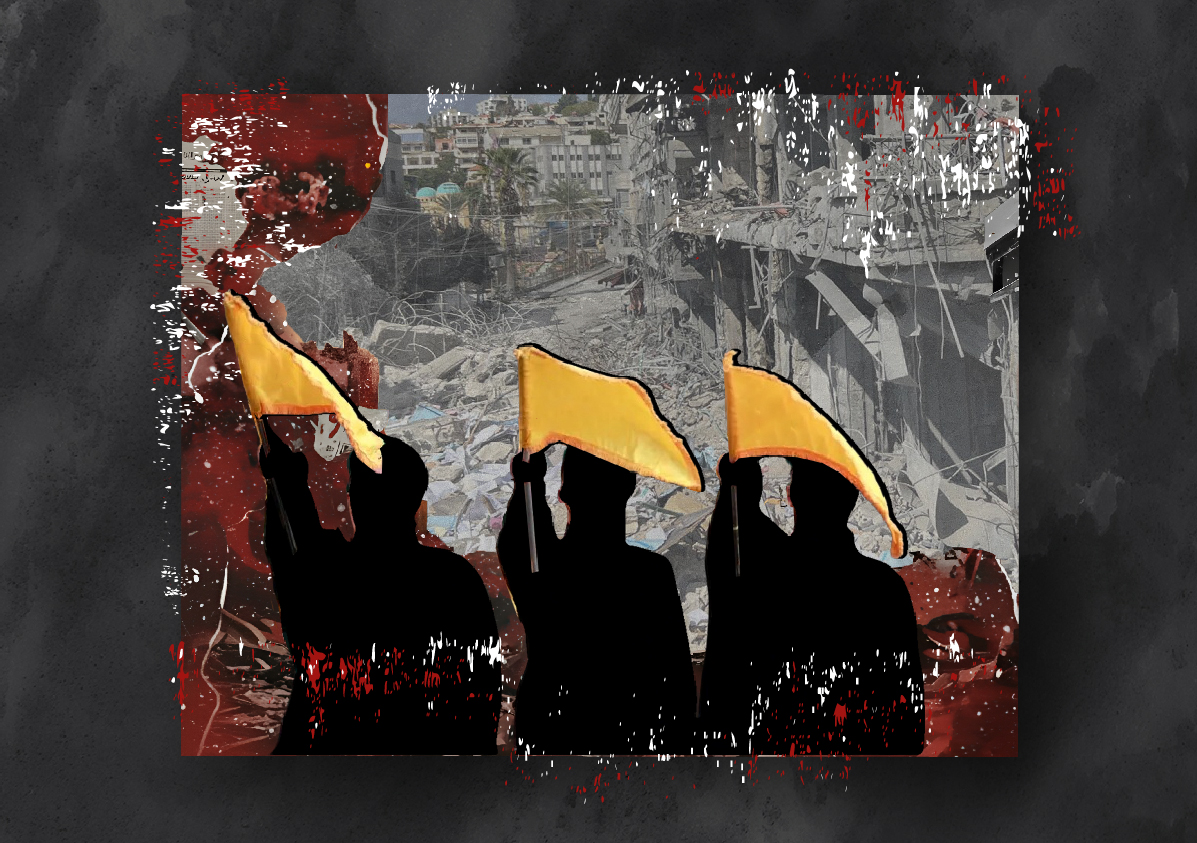
After roughly a month and a half of open war, and following negotiations sponsored by the United States that intersected with the broader American-Iranian negotiation track, a truce came into effect at midnight between April 16 and 17. Yet this truce began while a southern geographical belt, outlined in yellow and still under Israeli occupation, remained in place. The line did not merely encompass villages south of the Litani River, but also included large sections of villages north of the river, such as Arnoun, Yohmor al-Shaqif, and Eastern Zawtar. This was not a truce in the true sense of the word, but rather a new form of warfare, different from what had preceded it. A truce, in its real meaning, implies a suspension of hostilities between warring parties for a period of time without necessarily signifying the end of the war. That, however, was not what occurred here. Under the banner of this alleged truce, the war was effectively confined to the South—primarily to the area stretching from the border to the Zahrani River region. At times, it extended beyond that through waves of airstrikes targeting the heights and villages of the Iqlim al-Tuffah region.
Thus, one of the most fundamental pillars of any supposed truce—the military and security dimension—never truly materialized. For this reason, when news of the truce was announced, Hezbollah and Amal Movement urged people to delay their return. Many displaced residents, however, did not heed these calls, driven by the hardship and bitterness they had endured during displacement—especially those who had been living in shelters under physically and psychologically unbearable conditions. It should also not be overlooked that many of those who had rented homes during the war had become financially exhausted.
But for those who returned, things did not unfold as they had hoped. As the saying goes, the calculations of the field did not match the calculations of the harvest. Within only a few days, everyone realized that the truce was not truly a truce, but rather a conditional war disguised in the clothing of one. Some of those people once again returned to their places of displacement. Others—those living outside the frontline villages adjacent to the yellow line, areas now almost entirely emptied of civilians—remained behind, determined to wage a struggle for survival despite the daily missiles and deadly shelling, despite the constant fear, the total absence of safety, and the uncertainty surrounding what might come next. Yet once again, expectations collapsed. Even among those willing to endure all of this as a consequence of the continuing war, other obstacles emerged that made remaining in their towns and villages nearly impossible. The very foundations necessary for survival had, in many places, either eroded severely or disappeared altogether. The inevitable result was displacement once again. The first of these essential foundations was the economic one. Without a source of income, survival becomes impossible—especially given that economic activity there is now almost nonexistent. There are no local work opportunities, whether in agriculture, trades, or services, nor any practical means of marketing or selling production even where it still exists. At the same time, maintaining outside employment has become equally difficult because movement itself is both dangerous and severely restricted.
The second essential pillar is the network of basic services people need in order to live: electricity, water, transportation, communications, fuel, and food supplies. These are fundamental necessities for survival. A large portion of the state electricity infrastructure has been damaged, and in most cases there is no possibility of repairing it. Privately operated generator networks have also suffered extensive damage. Even those generators that survived have faced severe difficulties obtaining fuel in many areas. The only relative exception has been households relying on solar panels, particularly systems that were not damaged during the war. Their situation remains better than that of others. As for water, many villages now lack access to it altogether. This is either because some villages containing pumping stations—such as Taybeh and Wazzani—have fallen under Israeli control, because water lines have been struck, or because the employees responsible for operating these services are no longer present. Transportation routes have fared no better. Some roads have become highly dangerous, while others are no longer usable at all. Public transportation services have similarly dwindled to an extreme degree. Internet service is in equally poor condition, as is mobile phone coverage, whether due to the destruction of telecommunications infrastructure or signal jamming. The situation regarding food supplies and fuel is equally dire. A large number of shops have been destroyed. While villages farther from the frontline may still partially compensate for these shortages, the situation becomes far more difficult the closer one gets to the villages along the yellow line. Israel—particularly following its evacuation warnings—has targeted nearly every movement it observes in the warned villages and on the roads leading to them. A large number of civilians have lost their lives as a result.
he third essential pillar is healthcare. This issue was not merely one of the obstacles preventing people from returning to their villages; it also became an additional reason for the renewed displacement of those who had initially chosen to remain there. Many people require continuous care, whether through long-term home treatment or regular access to clinics, medical centers, and dispensaries. Pharmacies are equally indispensable for securing medication, yet many of them have shut down. The suspension of many of these services, combined with the dangers and difficulties of traveling to distant areas in search of care and treatment, became another major obstacle to remaining in or returning to the villages.
The fourth pillar is education. While in-person education in southern schools had effectively ceased, many schools shifted to remote learning—online education. This option proved significantly easier for students living in displacement, despite all accompanying hardships: first, because internet access was more likely to be available; and second, because the environment in displacement areas was generally safer and calmer than the increasingly violent conditions in the South, where escalation continued on a daily basis.
The fifth and final pillar is the absence of alternatives. In many of these villages, municipalities have become largely absent or operate with only limited capacity due to the overwhelming circumstances imposed by the war. The same applies to non-governmental organizations, as well as to other local initiatives. Before the war, these alternatives had played an important role in supporting residents and helping sustain life in the villages. At the same time, mass displacement and the enormous expenses that accompanied it have greatly reduced the ability of both local and diaspora-based supporters to continue meeting the needs of large segments of the population.
This, then, is the reality facing a large number of towns and villages in southern Lebanon. People may be able to endure the absence of one or perhaps two essential pillars of survival. But once the deterioration exceeds a certain threshold, remaining becomes virtually impossible, and displacement turns into the only available option. That is precisely what happened to many people. The experience of the southern villages during this war has made one thing unmistakably clear: endurance is not merely a slogan to be raised. It is the product of a balance among multiple essential foundations. Once these economic, service-related, healthcare, educational, and other pillars begin to erode, remaining becomes greater than what people can bear. At that point, displacement is no longer a choice, but rather the natural outcome of an increasingly harsh and collapsing reality.