.jpg)
I begin this article in response to a question that keeps returning insistently: what is the point of speaking about politics today, amid this absurdity that leaves us, as individuals, unable to make political decisions, unable to alter the course of wars or even stop them, and unable to prevent the genocide committed against Palestinians in the Gaza Strip or the ongoing war in Lebanon?
And yet speaking remains a necessity—even at the level of individuals, and even in its most minimal form—as a way of confronting the dominant narrative and breaking the “echo chambers” that imprison people inside bubbles where the same narrative, the same discourse, and the same ideology endlessly reverberate. In the age of the “trend” and rapid clicking, these bubbles quickly rise into virtual space, forming electronic tribes that reinforce the belief that anyone different is an enemy who must be excluded—whether symbolically or through violence. In this way, virtual space becomes a mirror of reality, just as reality itself becomes an extension of that virtual world. This is precisely what we have witnessed—and continue to witness—in Lebanon, for example, when a group of young men in the town of Doueir assaulted journalist Daoud Rammal because of his opposition to and criticism of Hezbollah’s rule and domination, alongside many other similar examples.
In such contexts, society becomes more conservative and inward-looking, while these practices begin at the individual level before gradually expanding into broader patterns of collective behavior. This is precisely where writing and speech acquire their importance: they make it possible to shed light on issues that remain, at least to some extent, open to change—unlike the decisions made by major powers.
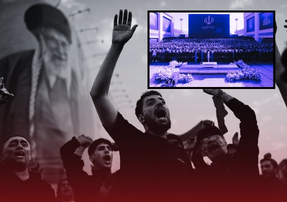
Although I remain cautious toward arguments about the return of a unipolar world, or of a single empire, and toward narratives surrounding the rise of far-right polarization, I nevertheless believe, in another sense, that many of the demonstrations that swept across European countries in support of Gaza, for example, ended up overlapping in certain respects with the discourse and slogans of the far right itself. Indeed, slogans supporting Hamas, Hezbollah, the various Iranian-backed militias, and even the Iranian regime itself became visible—despite that regime’s responsibility for grave violations against the Iranian people, whose exact number of victims remains unknown following the protests that erupted before the outbreak of the war between the United States and Israel on one side and Iran on the other.
This, in turn, granted Iranian officials greater legitimacy to continue pursuing their own agendas, since the pressure exerted by the street did not, in its seriousness, place an immediate ceasefire at the center of its demands. Rather—and this is my view—it reflected a sharp polarization between two opposing camps that ultimately converged at the very same point: extremism.
On the other side, a discourse has also intensified in Lebanon—one that, at its core, contains its own form of complicity and repression, even if it appears outwardly overflowing with humanitarian concern. This discourse is voiced by certain media figures, officials, and even some intellectuals, calling for the postponement of political debate on the grounds that the country is at war, and that priority should be given exclusively to the humanitarian dimension—particularly in light of the displacement crisis, worsening economic and social conditions, the absence of clear emergency plans, and the fact that society has yet to recover from the previous war.
Yet this argument, despite the apparent legitimacy of its motives, produces a problematic separation between the humanitarian and the political. Reality becomes reduced to little more than crisis management; the state begins to resemble a non-governmental organization; and public debate becomes confined to dealing with consequences alone. In this way, the emphasis on the “humanitarian” turns into a comfortable framework that absolves the party that initiated the war from responsibility for having initiated it in the first place, while postponing the more urgent questions: Why do these humanitarian catastrophes continue to repeat themselves in Lebanon?
Excessive Humanitarian Discourse: A Form of Dehumanization?
In recent times, humanitarian narratives centered on pain and suffering have become widespread. In itself, this is not objectionable. It does not mean concealing discussion about displaced Shiite families, including those who may support Hezbollah, since they did not necessarily choose to engage in this battle.
The problem lies rather in a form of discourse that limits itself to displaying the outcome—suffering—while obscuring the political and military decisions that produced this reality. When the humanitarian is detached from the political, the image appears stripped of context, and scenes of displacement come to seem like self-contained conditions rather than the consequence of choices made by Hezbollah—choices undertaken in retaliation for the killing of Supreme Leader Ali Khamenei, and which must remain open to criticism and accountability.
At times, the discourse goes so far as to reduce the entire situation to pity for the victims, as became especially visible during the war on Gaza. Many activists appearing on foreign media outlets focused almost exclusively on the humanitarian catastrophe without directing explicit criticism toward Hamas and its decision to launch the war known as the “Al-Aqsa Flood” on October 7. And, of course, one immediately hears the familiar objection:
“But what about Israel?”—as though any attempt to assign responsibility were automatically equivalent to denying Israel’s crimes. Yet this objection itself reflects a logic that demands the repeated reaffirmation of condemnation as a prerequisite for any discussion, rather than treating that condemnation as an already established reality that need not be re-proven every single time.
In this context, one may draw on the reflections of the German philosopher Hannah Arendt concerning what might be called the “spectacle of suffering.” Arendt points to a form of politics excessively centered on what is visible—that is, on transforming suffering into a spectacle available for observation. Human pain becomes reduced to an image to be watched and consumed. Arendt’s argument, to a large extent, seeks to uncover the implications embedded within this mode of politics. At its core lies the act of observation itself: the miserable are watched by those who do not share their suffering and do not experience it directly, thereby placing the latter in the position of the comfortable—or fortunate—spectator. Contemporary debates in political philosophy have also reached an impasse concerning the concept of “solidarity.” Solidarity is undeniably necessary in supporting peoples historically subjected to oppression, killing, marginalization, and displacement. Yet in forms that presuppose sameness in advance, solidarity also carries the danger of absorbing and erasing difference, and may ultimately turn into an exclusionary practice. In their respective discussions, both the German philosopher Hans-Georg Gadamer and Hannah Arendt argue that discourse sometimes slips into reducing catastrophe—as we have noted—to the level of mere “sympathy for the victims.” Solidarity then becomes tied to a form of compassion that simultaneously empties the event of its political dimension.
What emerges clearly from the tension highlighted in the discussions of Gadamer and Arendt is the conflict between two necessities: the need to stand in solidarity with victims of violence, and the danger that such solidarity may become a framework imposing a pre-established unity that erases differences and potentially excludes critical voices. Within the same context, the Slovenian philosopher Slavoj Žižek points to an ideological tendency that demands accepting things as they “are” on the surface, presenting such acceptance as the only rational stance possible. Yet this so-called “realism” ultimately closes off the horizon of thinking about alternatives, transforming reality into an untouchable given. Within this logic, the exclusive focus on suffering—detached from the events and decisions that produced it—becomes part of an ideological mechanism that stabilizes reality rather than questioning it.
George Orwell at the Lebanese Table?
There exists a discourse—still haunted by the trauma of the Lebanese Civil War despite the radically different contexts—that views Lebanon as divided into two opposing camps: one camp calling for peace with Israel, and another aligned with the Islamic Republic of Iran. This discourse tends to equate the two camps with one another, reviving a traditional reading found within certain Christian political currents, partially shaped as a reaction to the practices of the Christian right during the Lebanese Civil War and marked by an excessively humanitarian tendency. This perspective presents itself as a call for peace and coexistence, yet it carries within it a profound danger: the misleading equivalence it establishes between two camps that are not equal in either position or role. Quite apart from the simplification that reduces Lebanese society to only two camps, a fundamental question remains: How can one hope to avoid a humanitarian catastrophe without pointing to its actual causes or holding accountable the actors responsible for producing it?
How can one ignore the history of armed groups that glorified the “silencer,” suppressed all opposition, and sought to demonize every attempt to build a Lebanon outside the logic of external tutelage—whether American or Iranian?
And how can one overlook the fact that these same forces continue, to this day, to threaten the decisions of the Lebanese government and those who support it through their rhetoric, while excluding, harassing, and even assaulting people—including individuals from within their own “environment”—simply for opposing them?
Reflecting on Britain’s controversial struggle against Nazism, the English writer George Orwell observed that people raised in democratic or semi-democratic societies often find it extremely difficult to imagine a totalitarian atmosphere. They therefore tend to interpret realities outside their own experience through concepts derived from their personal world. According to Orwell, this tendency weakened much of what was written about the Soviet Union, the Spanish Civil War, and even Nazism itself.
Building on this analysis, one can better understand the limitations of the humanitarian discourse adopted by those who have never actually lived within this environment, or who have experienced it only from the outside. Such individuals often project onto reality the concepts of freedom familiar to them from their own lives, without fully grasping the conditions of repression that structure this environment. I am not speaking here about the state of public freedoms in general, nor about marginalized groups or women, but rather about another level of repression—one that affects even those presumed to belong to the supportive social base itself: namely, individuals who defend Hezbollah’s weapons or who are directly involved within its structures.
Numerous videos circulating at the beginning of the war revealed clear indications of this atmosphere: from the deployment of Hezbollah members around schools sheltering displaced people, to the interruption of certain media interviews, to online campaigns targeting individuals who expressed frustration over the party’s launching of rockets toward Israeli territory.
These incidents reveal how narrow the margin for dissent remains—even within circles considered close to the party—and how difficult it is to express any critical position outside the prescribed framework. Reflecting on the twentieth-century war between Britain and Nazi Germany, George Orwell wrote:
“In politics, there are no entirely good choices; there are only degrees of evil. And regardless of that, pacifists cannot escape politics.”