The month of March witnessed the confrontation shift from the level of localized strikes in southern Lebanon—and at times in the Bekaa Valley and Beirut’s southern suburbs—within what Israel had described as its “freedom of action” against Hezbollah in Lebanon, to what could be described as an open war between Israel and Hezbollah. This transformation was marked by the expansion of military operations and the multiplication of target areas across the south, the southern suburbs, the Bekaa, and Beirut.
The confrontation effectively began on the second day of the month, when Hezbollah launched six rockets toward northern Israel and announced its entry into the battle against it, marking the principal turning point in the escalation trajectory.
During the first third of the month, Hezbollah officially designated the confrontation as the “Eaten Straw Battle” (“al-‘Asf al-Ma’koul”), signaling a transition into a prolonged phase that surpassed the previous rules of engagement. In parallel, Israel escalated both its military and political rhetoric and moved from the outset to integrate the Lebanese front into a broader framework it called “The Lion’s Roar,” placing the confrontation with Hezbollah within an interconnected regional struggle involving Iran and its allies.
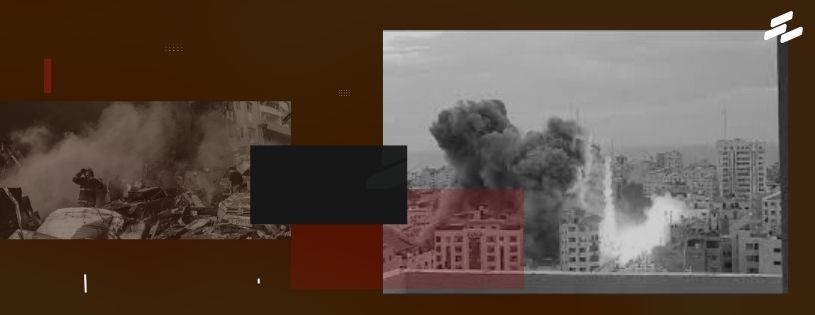
On the humanitarian level, the ongoing military operations resulted in a high human toll. Estimates by the Lebanese Ministry of Health indicated that approximately 1,268 people had been killed in Lebanon since the beginning of the escalation, including Hezbollah fighters and civilians, in addition to larger numbers of wounded and a broad wave of internal displacement, particularly amid the widening Israeli strikes targeting entire villages, neighborhoods, and residential sectors.
In this context, Israeli warning policies emerged as a tool of field pressure. Through its spokesperson Avichay Adraee, the Israeli army issued urgent evacuation warnings to residents of Beirut’s southern suburbs, particularly in Haret Hreik, Chiyah, Burj al-Barajneh, and Hadath, ordering them to immediately leave their homes and head toward designated areas.
The Israeli army also announced the beginning of a ground operation aimed at what Israeli discourse commonly described as the “cleansing of the border area,” extending to an estimated depth of around 10 kilometers inside Lebanese territory. Israeli Defense Minister Israel Katz further declared the implementation of what he called the “Beit Hanoun scenario” in southern border villages, implying the threat of widespread destruction of residential infrastructure in those areas.
Politically, the military escalation coincided with additional internal tensions following the government decision issued on March 2, which classified the military and security activities of Hezbollah as outside the framework of the law, in what was widely viewed as a shift in the official stance toward Hezbollah’s military role.
Hezbollah categorically rejected the decision and issued a series of statements stressing that its operations are based on what it described as “Lebanon’s right to self-defense,” affirming the continuation of its activities regardless of any local legal classifications.
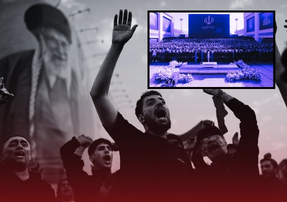
In its military and political approach, Hezbollah continued to promote a narrative portraying the current war as part of a broader confrontation with Israel, while maintaining a relative separation from the direct regional confrontation with Iran despite the practical overlap between the different theaters of conflict. Its discourse focused on the concepts of “mutual deterrence” and “Israel’s failure to impose decisive field equations,” arguing that the continuation of military operations aims to prevent the expansion of the aggression deeper into Lebanese territory.
A parallel narrative also emerged within Hezbollah’s discourse, claiming that the party had granted the Lebanese state approximately fifteen months to activate the diplomatic track and compel Israel to halt its violations, and that its shift toward military action came only after exhausting that path and in the context of taking advantage of the regional moment.
Media outlets affiliated with Hezbollah—such as Al-Manar, Al-Ahed, and Al-Akhbar—worked to frame the war within the concept of “preemptive defense,” emphasizing that it was the Israeli escalation that expanded the scope of the confrontation, rather than an initiative by Hezbollah to open new fronts. These outlets also highlighted Israel’s linkage between Lebanon and Iran as part of what they described as an effort to “expand the war to include the Axis of Resistance.”
Meanwhile, the Amal Movement maintained a supportive position toward Hezbollah, while adopting a discourse aimed at regulating the internal political climate, warning against the risks of sliding into internal civil strife and stressing the need to preserve domestic stability despite the ongoing military operations.
Within the Shiite community itself, opposition voices also emerged, arguing that the continuation of the war at this level imposes mounting human and economic costs on the local population, and that linking the Lebanese arena to broader regional conflicts only increases the risks. These positions called for ending the notion of military action outside the framework of the state and emphasized the concept of protecting Lebanon through state institutions.
At the same time, forces opposed to Hezbollah escalated their rhetoric, arguing that the ongoing confrontation constitutes an open war managed within regional calculations that transcend Lebanese borders. These groups expressed support for the government’s decision, while some media outlets—such as Nidaa Al-Watan—and partisan platforms affiliated with Kataeb Party adopted increasingly harsh language in describing Hezbollah, using terms such as “the party’s gang” or “the outlawed party.” This discourse formed part of a broader political call to restore the authority of the state and international resolutions, and to shield Lebanon from the trajectory of regional wars.
In sum, Lebanon now stands before an escalating war between Hezbollah and Israel at a critical regional crossroads, amid sharp disagreement over the nature of the conflict between those who view it as a defensive war and those who consider it an extension of a broader regional struggle. This division is clearly reflected on the domestic level, raising the prospect of growing political and social tensions. With military operations continuing and no clear political horizon in sight, the possibility of a wider confrontation remains present, placing the country before an extremely sensitive political and security phase.