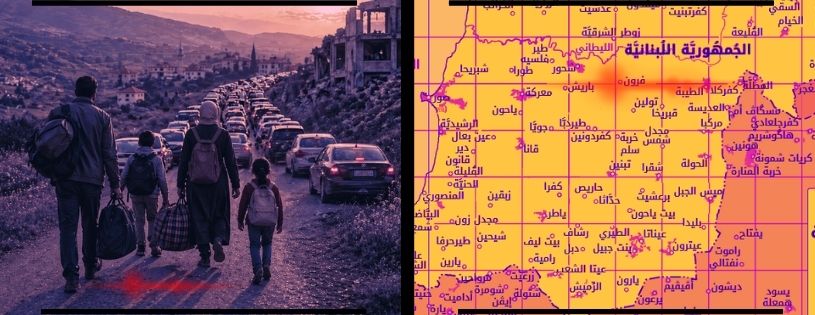
The people of southern Lebanon waited anxiously for the ceasefire between Hezbollah and Israel to come into effect—a temporary ten-day truce that according to Donald Trump, could pave the way toward a comprehensive agreement. Some waited at the Qasmiyeh Bridge at midnight between Thursday and Friday for the road to reopen so they could return to their homes, while others set out toward their villages and towns at daybreak. We left by car toward our village in the Bint Jbeil district at eight in the morning. Traffic congestion was already visible starting from Khaldeh: cars, trucks, motorcycles, and residents carrying what belongings they could, buying food supplies along the way, all heading back toward homes they had abandoned suddenly after waking in the middle of one Ramadan night to news that rockets had been launched from Lebanon toward Israel, followed by Israel’s announcement of a brutal assault on Lebanon. The traffic grew heavier little by little until reaching the Abu al-Aswad area, where the road overflowed with a sea of vehicles in a scene that recalled the ominous days of mass displacement on September 23, 2024, and March 2, 2026.
he road leading to the Qasmiyeh Bridge—which had been destroyed the day before the ceasefire and was originally designed for two-way traffic—was used entirely by vehicles heading south. Traffic was interrupted only by a handful of ambulances coming from the opposite direction, further worsening the congestion.
As traffic came to a halt for long stretches of time, some people stepped out of their vehicles to rest and restore circulation to their exhausted limbs. Women led their children to the roadside so they could relieve themselves. Others moved away from the endless line of cars in search of an internet signal to check the latest news. The emotions of those stranded in traffic appeared deeply mixed: joy at returning to their towns, fear that their homes might no longer be habitable, and anxiety that the war could erupt again at any moment.
Abu Hassan told Van No. 4 that he had been displaced from his town of Jouaya on the very first day of the war and had since been living with his family in one of Beirut’s displacement shelters. Today, he was returning to Jouaya after a second long absence within just three years—except that this time, he did not know whether he would be able to stay or whether he would once again be displaced after the ten-day truce expired.
At the Qasmiyeh Bridge, security forces had piled mounds of earth around the targeted crossing in order to allow cars and vehicles to pass. The improvised road was rough and narrow, permitting only one vehicle at a time, which further intensified the traffic congestion and long hours of waiting. As the sun climbed higher, the wait became nearly unbearable.
We crossed the bridge after several exhausting hours and continued toward the city of Tyre. At the city’s southern entrance, a group of young men stood holding party flags while songs of “victory” blared from loudspeakers—a victory whose traces were impossible to detect on the exhausted faces inside the cars.
As we moved farther toward the Bint Jbeil district, the scale of destruction gradually became clearer. In particular, the towns of al-Bazourieh, Jouaya, and al-Shaabiyeh presented devastating scenes: residential buildings and commercial establishments completely destroyed along both sides of the road. What had survived had nevertheless suffered severe damage. Shopfront windows were entirely shattered, exposing the goods inside and making theft far easier—a problem residents say has become increasingly widespread.
In al-Sultaniyah, where we arrived after more than ten hours on the road, none of the basic conditions for life remained. Electricity was completely cut off, water service networks were out of operation, and internet access was so weak it could barely be detected.
All the shops were closed. There were no restaurants, naturally, nor any butcher shops, grocery stores, or bakeries. Meanwhile, the sounds of shelling and explosions never ceased. The bleakness of the scene was deepened by thick fog and heavy rain, accompanied by thunderclouds whose rumbling merged with the sound of the bombardment.
The shelling continued throughout the entire night. Drones and warplanes never left the sky. After checking on our property and surveying the painful damage, we gathered a few belongings and headed back toward Beirut on Saturday morning—this time passing through the towns of Burj Qalaouiyeh, Srifa, and Burj Rahhal before reaching the main highway.
The scene on the return journey was no different: massive destruction, collapsed homes, and ruined businesses everywhere. In Srifa, for example—a town targeted during the war by successive waves of devastating bombardment—words could scarcely capture the horror of the landscape. Along both sides of the road, residents wandered through the wreckage of their homes and shops, while shattered glass and stones lay scattered across the streets.
At the same time, warnings from the Israeli army continued urging residents of the South not to return to areas south of the Litani River, while media outlets affiliated with Hezbollah quietly circulated advice urging people not to settle back in and instead to return quickly to their places of displacement. And so another endless line of cars began to form—another long and exhausting journey, this time toward an unknown and increasingly bleak fate, amid rising fear and deepening pessimism. Prolonged displacement, the loss of homes, and confronting devastation seem to have become the destiny imposed upon the people of southern Lebanon. What they need are radical solutions capable of rescuing them from this ongoing nightmare. Most no longer care about what unfolds in negotiation rooms or about the outcomes of geopolitical power struggles. They have already paid an immense price, and in the end, they simply want to rest—whatever the cost may be.