(1).jpg)
I carried nothing with me but a single bag on the day people were driven out of the southern suburbs of Beirut—the day of the great threat.
Just one bag, too small to hold my first wish: that I could somehow squeeze this entire home into it.
A slightly childish wish, perhaps.
Maybe the child I once was had resurfaced from the depths of memory. Or maybe it is what war does to us—shrinking us back into children: afraid of everything, yet at the same time capable of reckless leaps into danger.
The child who trembles at the sound of thunder is the same child who might throw himself off a rooftop, convinced he can fly.
Perhaps this wish was nothing more than an attempt to begin this text with a “strong” opening.
And yet, the desire to carry the house inside that bag has not left me since this devastating war began—on that blood-soaked October 8, in what feels like the first year of an ongoing catastrophe.
Be that as it may, the course has been set. The furnace of war is raging beyond control—there is no refuge from it now; neither mountain nor ship.
On March 2, around two in the morning, people rushed into the streets, each carrying as many bags as fear had allowed them time to pack—if they had not packed them in advance.
One man clutched his son’s or daughter’s hand; a woman held her father’s hand, while he leaned on a cane to steady his aging body.
On the right side of the street, someone shouted at his brother, urging him to bring the car quickly before they lost their place near the front of the line of departing vehicles.
A little to the left, a father ordered his family to leave on foot, their legs already exhausted, entrusting the mother with the children: Wait for me at the edge of the suburb. I’ll go get the car. And if the beast kills me, try to stop it from taking you too.
People’s circumstances differed, as did their fears.
What united them was only this: moving toward an unknown—dark and terrifying.
That day, we packed some of our belongings, but we did not leave. The bags remained scattered in the corners of the house.
And some of those who had left returned home—simply because they could not get through the suffocating traffic. So they chose, with a brutal kind of simplicity, to gamble with fate and stay until morning.
In the three days that followed, “smaller” threats targeted buildings relatively far from us.
At daybreak, I would step out onto the balcony and see cars parked at the entrances of buildings—collective alertness, a constant readiness to leave at any moment, in a state that lasted only a few days but felt suspended in time.
Then came the afternoon of March 5.
We left amid a human frenzy, as if the dead had risen from their graves for the Day of Judgment.
To the hysterical sound of gunfire, we left. And inside me was the feeling that this was the day I would carry my family—after they had carried me during the July War of 2006, and in all the wars that followed upon this community.
The atmosphere that engulfed the neighborhood—gunshots, shops shutting down when they had not even closed on the first day, people arguing over which direction to take—stripped one of any ability to hold onto the most optimistic scenario.
It left no room for thought beyond one thing: to leave.
At one of the intersections, two young men were fighting, one of them firing at the other. The road was packed with armed men trying to control the flow of traffic.
While my father hurled curses in every direction, my mother called upon al-Zahra, like any devout Shiite woman. She was not praying out of fear of an airstrike, but of a stray bullet—one that might leave the barrel of one of those rifles and find its way into my head. I tried to shield myself from that possibility by keeping close to the car in front of me.
I was being selfish—but so was the driver of that car. He suddenly turned around and drove back the way he had come, leaving my car exposed, at zero distance from the two men, whom others eventually managed to pull apart.
At the entrance to the southern suburbs, from the Hadath–Choueifat road, the Lebanese Army, along with a group of young men, was organizing the exit. We were not allowed to head toward Hazmieh; a soldier ordered us instead to go toward Choueifat.
What were we supposed to do? He was telling us to go south—while the beast itself was warning and roaring from the south.
In any case, we moved on, in a journey that took three hours—one that, in “peacetime,” would have taken half an hour, or at most an hour if we had decided to stop at a restaurant along the way.
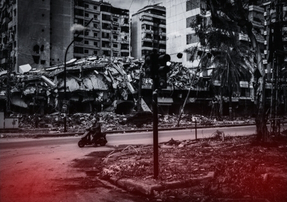
From where I am staying temporarily, I watch the destruction of the “suburb.”
A person’s relationship to a place changes once they are forced out of it. It changes in a radical, almost violent way—dirty alleyways acquire a strange kind of beauty. And the “safety” of displacement becomes unsettling when the place we were expelled from is no longer safe.
But what can be done? Had it been safe, we would not have been driven out of it.
And here we are, having now lived through a second exodus in just two years—watching, before our eyes, the Republic of the “Suburb” being demolished.
It is a republic, truly—a republic that resembles nothing but itself. In the way its people relate to it; in the class hierarchies of its districts and neighborhoods; in its networks of fear and its expressions of defiance; in its noise and its stillness; in its life and its death.
It is an experience worth pausing over, deeply and at length. This geographic space, whose demography and social strata were reshaped by the civil war, slowly transformed into a kind of republic—with its own capital, neighborhoods, social classes, major markets, and security zones.
A republic built in war, that lived through war—and is now being destroyed by war once again.
The areas of Haret Hreik, Ghobeiry, Chiyah, and Hadath represent the bourgeois zones—the centers of its political weight and its lines of contact.
Meanwhile, areas such as Mreijeh, Tahwitat al-Ghadir, and parts of Lailaki are considered zones of the petty bourgeoisie, where there is relative security and stability—or, more precisely, they mark the last boundaries of the bourgeoisie and the first edges of the Shiite proletariat.
This proletariat extends into areas like Hayy al-Sellom, Sahra Choueifat, and their surroundings—places marked by recurring problems and shifting clashes.
Of course, these areas are not exclusively inhabited by their respective classes. The proletariat moves constantly through bourgeois areas and dreams of settling there when their income allows. The reverse is also true: before the 2019 crisis, the markets of Hayy al-Sellom were frequented by residents of more bourgeois neighborhoods.
Then came the financial boom among those dealing in dollars, pushing some from proletarian zones into bourgeois ones—if only at the level of consumption.
In general, classes mix during the day, but at night, everyone returns to their own neighborhood—the one that signifies their class.
The people of the “suburb,” mindful of the sentiments of Hajj Mohammad Karl Marx, maintain at least a minimal effort to keep these class divisions from being too visibly displayed.
“The suburb,” in this sense—with these overlapping images that build it up and tear it down at the same time; “the suburb” as a largely unique Shiite experience—has now become a past that does not seem likely to return.
It is being demolished, neighborhood after neighborhood, building after building. And with it, every possibility of life rising again from the rubble is being destroyed. It is being torn down live, before our eyes.
And after this exodus, another chapter will be written—following the chapters of dispersion and wandering. Perhaps the “suburb” will become, in that story, a promised land for some of the families of the southern villages that the beast has leveled to the ground.
On a horizon obscured behind black clouds that swallow its symbolism; in a long, cold war, like winter nights—there is a future being written for the “suburb,” and for the other republics of this country.
And whether the “suburb” becomes a promised land or a forbidden one, what it once was no longer seems possible for it to be again—because it is being destroyed… live, from the air, and on the ground