October 2025 witnessed a marked escalation in the political confrontation surrounding Hezbollah’s weapons, with this confrontation moving from media and political debate into concrete government actions. Central to this shift were:
the government’s plan to restrict all arms to the state;
the increasingly strained relationship between Hezbollah and the Lebanese government—particularly Prime Minister Nawaf Salam;
the controversy over lighting the Raouché Rock;
and the suspension of the license of the “Ressalat” association.
In parallel, Hezbollah and its allies intensified their mobilization rhetoric, tightening communal cohesion and working to rebuild symbolic legitimacy after recent security blows. At the same time, a growing number of Shiite opposition voices—including the “Meeting of Lebanese Shiites” and several media platforms—sought to project an alternative narrative within the community.
Throughout the month, Hezbollah reinforced a three-tiered narrative:
- Hezbollah’s weapons are a “red line” and not subject to operational negotiation.
- The Lebanese government is acting under direct American pressure, making continuous concessions to Israel.
- Israeli violations justify the continued function of the “resistance.”
Statements by Deputy Secretary-General Naim Qassem, MP Mohammad Raad, and numerous members of the “Loyalty to the Resistance Bloc” reflected this trajectory. They repeatedly emphasized that:
- Hezbollah is in a phase of “recovery and rebuilding.”
- Any discussion of disarmament is “a direct service to the American-Zionist project.”
- The Lebanese state is “incapable of protecting the South.”
Through its military media outlets and channels such as Al-Manar and Al-Ahed, Hezbollah also worked to link its weapons to national sovereignty, framing every government step toward arms exclusivity as a hostile act.
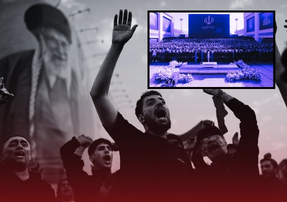
October 2025 saw Hezbollah heavily rely on martyrdom memory as a central mechanism to reassert its legitimacy one year after the assassination of its historic leadership.
Commemorations for the late Secretaries-General Hassan Nasrallah and Hashem Safieddine spanned the entire Shiite geographical sphere through:
- central mourning assemblies,
- cultural festivals,
- union delegations to shrines,
- student and scout gatherings,
- women's and cultural events.
These activities aimed to reaffirm the narrative that “martyrs” are the source of political and military continuity, and that any challenge to Hezbollah’s weapons constitutes a betrayal of their “will.”
Though Hezbollah publicly reiterated its commitment to the ceasefire, indirect threats remained consistent:
- hints that it could “overturn the table,”
- suggestions of possessing strategic surprises,
- messaging that patience “is not weakness.”
This restraint was presented as an ethical, national decision—not the result of military constraints.
The fallout from the Raouché Rock lighting incident and the decision to suspend the license of the “Ressalat” association formed a major friction point between Hezbollah and the newly formed government.
Hezbollah framed these developments as:
- a test of the state's intentions,
- a preliminary indicator of future political confrontation.
Its discourse quickly evolved from defending its Raouché activity to asserting that what occurred was:
- “a direct targeting of the Shiite environment,”
- “the politicization of law,”
- “an act of appeasement toward foreign powers.”
Alongside these developments, October 2025 saw a notable rise in Shiite internal opposition movements—expressed through statements from border towns, media platforms, and civil initiatives such as:
- The Meeting of Lebanese Shiites,
- Groups of southern residents affected by the war,
- Independent activists working on compensation and reconstruction.
Their discourse rested on core themes:
- Holding Hezbollah responsible for the outbreak and catastrophic consequences of the “Support War.”
- Accusing the party of obstructing compensation payments through Al-Qard Al-Hassan.
- Questioning the effectiveness of the deterrence model after major security breaches.
- Rejecting the transformation of the Shiite community into a hostage of permanent military choices.
Some statements attributed to residents of southern border towns directly blamed Hezbollah for:
- obstructing solutions,
- blocking compensations,
- maintaining villages in a state of chronic destruction.
The upcoming parliamentary elections emerged as a key driver of political behavior within the Shiite environment. The Amal–Hezbollah duo worked to:
- frame the elections as “existential elections,”
- emphasize their centrality to the Shiite community,
- and Hezbollah tied them directly to “loyalty to Sayyid Nasrallah.”
Opposition groups, however, argued that this narrative aims to:
- heighten sectarian tension,
- mask socioeconomic and security failures,
- prevent internal breakthroughs,
- and bind the community’s choices to Iranian political strategy.
The events of October highlight a clear imbalance in state–community relations:
- The state is making slow, tentative progress toward regaining a minimal level of authority or providing reassurances to Lebanese Shiites regarding their political, security, and economic future.
- Meanwhile, Hezbollah retains a strong ability to obstruct, mobilize, evoke symbolic narratives, and emphasize the dangers facing the community if it abandons the party or its weapons.
Although Hezbollah and Israel maintained a general ceiling of field containment throughout October 2025, political and security indicators suggested that the risk of escalation remains present, albeit with varying degrees and not necessarily pointing to an imminent full-scale war.
Repeated Israeli strikes—targeting vehicles, drilling machinery, and the continuation of assassinations—exerted cumulative pressure on Hezbollah’s deterrence structure, even if they did not prompt an immediate response.
Hezbollah, in turn, attempted to absorb these attacks while projecting that this restraint:
- serves the interests of the Shiite community by avoiding an open confrontation,
denies Israel an opportunity, especially amid intensifying international pressure to implement the state-monopoly-of-arms plan.