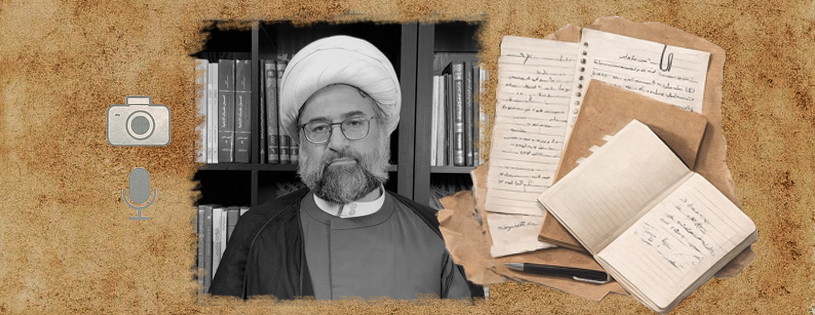
Recently, the scholar Sheikh Mohammad Ali Al-Hajj Al-Aamili began publishing videos titled “Contemporary Visions” across various platforms. In them, he presents jurisprudential issues in a manner different from what has prevailed in the Lebanese Shiite community since the rise of Absolute Wilayat al-Faqih in the region. Through these platforms, the son of the southern town of Shhour offers content similar to what he has been publishing for years in books, studies, and articles on religion and society. By doing so—consistent with his longstanding calls for reform and renewal, and his interest in strengthening interfaith relations—the Sheikh seeks to reach the widest audience possible, opening new horizons for thought and reflection rather than reinforcing the narrative promoted by dominant sectarian parties for political purposes disguised as religion.
The platforms of the founder of the Imam Al-Sajjad seminary in the southern suburbs, who has long been interested in the history and development of religious seminaries, do not aim to delve into daily political clashes, nor do they adopt everyday socioeconomic headlines that turn religious scholars into actors in political conflicts. Instead, they attempt to elevate awareness within the Shiite community in Lebanon, especially now that the degrading rhetoric of many clerics has become a discourse serving political agendas rather than the community’s well-being.
I conducted an interview with Sheikh Mohammad Ali Al-Hajj about his experience and his effort to keep pace with contemporary developments. When I met him—and although I am usually apprehensive about meeting some religious figures—I felt I was in the presence of a scholar who is easy to converse with and who commands respect through his humility, openness to dialogue, rational approach, and readiness to answer every question. These qualities make communication not only possible, but effortless.
The Sheikh chose the title “Contemporary Visions” for his platforms because he believes that “religion can only be understood through contemporary perspectives.” He explains: “If we look at the experience of the Prophet Muhammad (PBUH), we see that the main reason he was able to elevate Arab society at the time was his contemporary and forward-looking vision. He led a primitive society out of backwardness into one that was more distinguished, more conscious, and more understanding of life, enabling them to advance and develop.”
The Sheikh considers that “in our present time, whether in the Shiite context of Lebanon or in the broader Sunni context of the Arab and Islamic region, the discourse of clerics and religious institutions is, overall, regressive and reactionary. It seeks to take people back more than ten centuries, whereas the Prophet wanted societies to progress.” He adds, “We are not speaking of a new belief in God, but rather saying that religion is conduct, treatment, and a way of life. Ultimately, this religion can only be a progressive one.”
The Sheikh believes that “one of the greatest crises within our Shiite community—one that has led to the complexities we see today in the sectarian situation—stems from this ignorance; and by that I mean religious backwardness. This is our fundamental problem, because it creates space for some to exploit religion and drag it into matters that are not its domain.”
While people often speak of clerics interfering in politics, he points out that, at a deeper level, “it is politics interfering in religion,” not the other way around—something that becomes clearer as he continues speaking.
Sheikh Al-Aamili believes that “the dysfunction present within the Shiite religious sphere is, for the most part, the result of inserting religion into matters that do not concern it. Islam is not meant to be invested in political disputes or in the conflicts of partisan power. Islam is far more elevated and greater than that.” This view was once dominant among Shiite scholars before the rise of Wilayat al-Faqih in Iran, as many of them held that it was not the role of the jurist to rule.
From this perspective, the Sheikh began publishing concise platforms addressed to the public—some of whom appear receptive to a discourse that differs from the prevailing one. He explains that he intentionally avoided lengthy or complex elaborations, opting instead for “quick prompts—brief provocations of thought—regarding certain ideas that must be directed toward sensitive issues.” Indeed, these “prompts” encourage thinking outside the dominant frameworks used to contain and define the Shiite community.
Al-Aamili laments that “the discourse of clerics in our Shiite reality has become captive to several factors: the interests of the official Shiite religious institution in Lebanon, the prevailing political situation in our country, and cultural and intellectual legacies that are not necessarily Islamic in nature. Some of these legacies may even be tribal, clannish, or socially backward, with no connection to the pure Islamic religious thought. For this reason, we believe there must be a religious discourse that is more conscious, more open, and more humane.”
The Sheikh believes that one of the reasons for misunderstanding religion lies in restricting and confining it, and in constantly conflating religion with religious thought, as well as human interpretations with divine texts. He adds: “We often sanctify matters that are, in reality, not sacred at all. Yet we have sanctified them simply because they were handed down to us as part of our intellectual heritage.”
He points out that one of the goals of the “intellectual prompts” he offers is to raise people’s awareness so they can distinguish between what is fixed and foundational, and what is not. He notes that there are many jurisprudential matters in which a person may legitimately hold their own opinion.
He also stresses that it is incorrect to assume that certain rulings are absolutely immutable: “There are indeed religious rulings that can change due to factors such as time, place, and surrounding circumstances, leading to what jurists call a ‘secondary ruling.’”
He explains further: “Sometimes there is a primary ruling—for example, drinking water is permissible. But a secondary ruling might make drinking water forbidden if it is harmful, or obligatory if one’s life depends on it.”
The Sheikh regrets that people often confuse what is fixed with what is variable—between the essential matters where no interpretation can override the text, and those matters where human beings have a margin for legislation or understanding. These fall under the Prophet’s saying: “God, God, in the order of your affairs.”
Despite the overwhelming flood of politicized religious content on various platforms—content designed to reinforce hegemonic control over public discourse—his renewal-oriented initiative has nonetheless found resonance, even though it is the effort of a single individual without an institutional apparatus behind it. This resonance appears to be growing with time, as many people seeking a unifying discourse—one that moves away from incitement and division—have embraced his work.
The Sheikh receives calls from individuals asking him to shed light on issues they wish to explore outside the prevailing political exploitation of religion. What draws his attention even more, however, are the requests from followers asking him to address certain historical topics: “One can sense how history influences our reality,” he says, “how people feel the weight of history, how they look to it for lessons, and how they try to understand their present and future through their past. This struck me deeply.” These historical issues have long been manipulated to serve political agendas and to fuel sectarian division. Addressing them, he believes, serves a broader Islamic public interest.
Regarding the followers of “Contemporary Visions” who long for a unifying discourse, the Sheikh says: “Some people have had enough of the rhetoric of the past. Everyone has seen where it has led.”
Among the reactions he receives from across the Arab world are requests to discuss matters related to Sunni-Shiite or intra-Islamic relations: “Some ask, for example, to talk about the wives of the Prophet or about Lady Aisha. One scholar told me that this type of discourse is missing in our environment, because the prevailing rhetoric among clerics in Lebanon is consumed with daily, mundane details, while what we need is discourse that builds awareness independently of all these peripheral influences.”
One of the most striking positions held by the Sheikh is his call for the adoption of a mandatory civil personal status law—a proposal fiercely opposed by clerics in Lebanon, despite the suffering it causes women, because such a law would undermine their authority as well as the authority of the political system they are tied to. But Sheikh Mohammad Ali Al-Hajj holds an advanced view on this matter.
He calls for a civil law that is obligatory, not optional, arguing that an optional law would be “worse than the current religious personal status system. The state’s decisions must be binding for all its citizens. One cannot assume that citizens have the choice to regulate their affairs this way or that. Does a person choose, for example, to register their home with a cleric? Religion is not limited to personal status issues; it is far broader… And the best interest of religion—primarily to preserve its sanctity—is for the state and the civil authority to regulate matters that fall within their own proper domain.”
Thus, the Sheikh sees the separation of religious institutions from the state as a way to protect religion from the behaviors and shortcomings of human beings. He also calls for clerics to regulate their internal affairs independently—without organic ties to political authority, without connection to the state, and without receiving privileges from it.
He believes that such entanglements create mutual interests between the state and religious figures, placing the latter under the authority of political power—“and this is extremely dangerous.”
The Sheikh criticizes clerics’ acceptance of becoming state-appointed religious authorities, arguing that a cleric working within Dar al-Fatwa, the Higher Shiite Islamic Council, or similar institutions becomes a hostage to political leaders.
“These authorities become wires connected to the ruling power, subordinate to the Prime Minister’s Office. The cleric is a state employee appointed by political authority and subject to the political tensions and decisions within each sect. This is unlike, for example, the patriarch, who is appointed solely by the clergy and can influence the state—whereas neither the President nor the Prime Minister has influence over the patriarch. The experience of Islamic bodies within the state shows that clerics are employees like members of the military: they are appointed by official authority and receive salaries from it. And the civilians who elect the Shiite Council outnumber the clerics themselves—so how can it be considered a religious authority?”
From Al-Aamili’s perspective—as reflected in his discourse—Islamic religious institutions have created a monopoly over the work of clerics and exert influence over them as a means of domestication. He describes the sectarian “representative bodies” before Lebanese society as forms of prestige that have nothing to do with religion: “The Speaker of Parliament benefits when these institutions allow him to dominate Shiite clerics, just as the Prime Minister benefits from Dar al-Fatwa and the Sunni Sharia Court to control Sunni clerics. This is how the role of religious scholars is constrained.”
The Sheikh recalls the words of Sayyid Mohammad Hassan Al-Amin, who said that religious institutions are the very pillars of Lebanon’s sectarian system, and therefore do not provide a genuine religious service at all. Yet he believes their existence could be positive if they operated with internal organization among clerics themselves, detached from worldly gains.
While the delayed establishment of Shiite religious institutions within the Lebanese state is often portrayed as the result of the marginalization of Shiites—and while this narrative is frequently used in Shiite rhetoric to convince the community that it was excluded—Al-Aamili offers an interpretation that challenges this storyline.
He explains that with the creation of Greater Lebanon, Shiites lagged behind others—including even the Druze—in establishing their religious institution. He continues: the late establishment of the Shiite religious institution had its own rationale: “The great Shiite scholars—such as Sayyid Abdul Hussein Sharaf al-Din and Sayyid Mohsen al-Amin—did not want to open any gateway that would allow clerics to become connected to political actors.”
He notes that prior to the arrival of Imam Musa al-Sadr in Lebanon, the Lebanese state had approached Shiite clerics in earlier periods, seeking their cooperation in certain matters: “The authorities asked Sayyid Abdul Hussein Sharaf al-Din to organize some issues. But our scholars considered that such involvement would demean the cleric, and they rejected any relationship that would place them within the framework of the Lebanese state. Sayyid Mohsen al-Amin told the French High Commissioner explicitly that he refused to oversee Muslim affairs in Syria at the time.”
However, Al-Aamili remarks that when the stature of Shiite clerics declined, some accepted certain benefits under what was then called “organizing the affairs of the Shiite community”—which, in reality, was an effort to package and integrate the Shiite sect more deeply into the Lebanese state structure.
He argues that the establishment of the Higher Shiite Islamic Council, the Ja‘fari Fatwa Office, and the Ja‘fari Sharia Courts resulted in around 100 clerics becoming employees within official state institutions: “These individuals became entry points for the state and political authority into the clerical class. They receive privileges such as immunity and specific budgets, and in return they help cover up corruption and prevent accountability within the sect.”
He adds that today, the Shiite Council suppresses diversity and fights anyone who attempts to cultivate plurality among Shiites—unlike Musa al-Sadr, who sought to foster such diversity.
Among the issues raised by Sheikh Al-Aamili is the “politicization of the Husayni revolution.” This is something any ordinary observer of Ashura mourning gatherings in recent years could easily notice, particularly how the narrative of Karbala has been politically instrumentalized. For example, Hezbollah has used these gatherings to magnify or exaggerate certain aspects of the Husayni story in accordance with the political narrative it seeks to promote.
Al-Aamili believes that the distortion of the Karbala uprising began with the rise of what became known as Islamic political movements. For him, the way the Shiite community engages with the Husayni revolution in this era “constitutes a deviation in the historical Shiite approach to Karbala, because the Karbala uprising was a revolt against a religious authority. Yet today, it is as though we are saying that religious authority is infallible and cannot be challenged.”
He adds: “Some clerics claim that Karbala sought political reform. This is not true. Imam Husayn’s goal was not political reform. Had Yazid simply been a political ruler, Husayn might have taken a different stance. But Yazid stood in the position of the Messenger of God (PBUH); he was considered the caliph of the Muslims and the head of the Islamic social hierarchy at that time. When Husayn rose up against him, he was fighting a religious authority specifically. He sought religious reform. But some people have no interest in discussing or acknowledging the need for religious reform, so they insist that Husayn sought political reform. No—Husayn sacrificed himself, his family, and was martyred for the sake of religion, not for a political position.”
The dominant discourse in today’s Shiite community often presents calamity as the Shiites’ eternal destiny. But Sheikh Mohammad Ali Al-Hajj believes that disasters can, in many cases, be avoided. He explains that while calamities were “sometimes inevitable and unavoidable, in most cases, there were alternative solutions.” He warns that a single mistake in a given domain can lead to catastrophe: “Calamities can sometimes be prevented, but poor management of public affairs inevitably leads to disasters.”
The Sheikh notes that some events considered historical inevitabilities—calamities said to have been imposed by fate—are not accurate upon closer examination. He points out that misjudgments in earlier eras also led to disasters, saying: “The history of Jabal Amil is full of catastrophes. In several historical periods, they were the result of poor administration and poor judgment. Thus, sometimes calamity is not destiny.”
While those who dominate the Shiite scene in Lebanon today portray the situation as though Shiites are fated to remain afflicted, persecuted, and killed, Al-Aamili—who avoids delving into politics—calls for “reflecting on the safest ways to govern our communities. Our best protection is to learn from past experiences and to avoid forming external alliances that provoke internal tensions, just as some Lebanese sects once provoked others with their foreign ties.”
Meanwhile, Hezbollah continues convincing its base that calamity is an inevitable fate for Shiites, that another Karbala is unavoidable, and that prevention is futile. Yet Al-Aamili notes that for more than two decades, Karbala was not the dominant rhetoric within the Shiite community: “Quite the contrary—some leaders promoted reconciliation, as Imam Hasan (peace be upon him) once did.”
He adds that “the Karbala rhetoric resurfaces when its function is to soothe wounds or, at times, to cover up mismanagement.”
As Sheikh Mohammad Ali Al-Hajj continues his years-long effort to promote a conscious discourse that frees religion from political exploitation, the unfolding events in Lebanon only reinforce the wisdom of his call—to liberate religious speech from political manipulation and restore it to its rightful space.