In recent days, Beirut’s southern suburb has witnessed a growing phenomenon: many of its residents are choosing to sell their apartments and residential units and replace them with homes in areas outside the suburb. This trend appears to be one of the reasons that prompted the municipality of Hadath to raise banners warning residents against selling or renting their properties, out of fear of a “Shiite influx”—a decision described by activists on social media as discriminatory, while others argued it was necessary to preserve the town’s (Hadath’s) identity.
This phenomenon did not emerge in a vacuum. It has been driven by several factors, most importantly the search for safer and more stable areas, particularly amid rising Israeli escalation and talk of an upcoming round of fighting aimed at eliminating Hezbollah, according to Israeli officials and an increasing number of Israeli media reports in recent weeks.
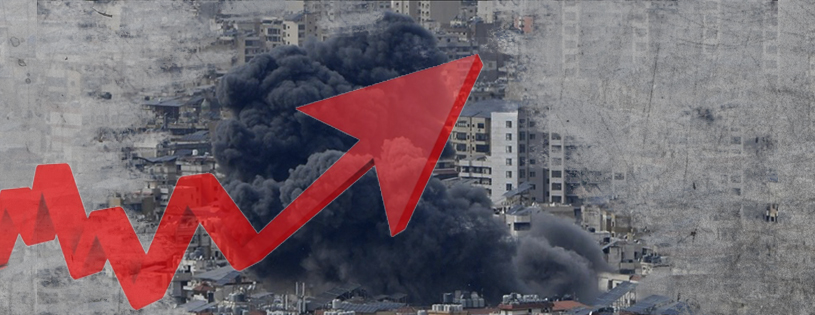
At the same time, the southern suburb is suffering from immense pressure due to a severe shortage of housing units. This shortage is a direct result of the recent Israeli war and the destruction it caused to buildings and infrastructure in the area. While various estimates indicate that around 100,000 units were destroyed—ranging from complete destruction to partial damage—researcher Mohammad Chamseddine from Information International confirmed, upon inquiry regarding the exact scale of the destruction, that 9,000 residential units were completely destroyed, and 62,000 units sustained partial or significant damage.
This may explain the surge in demand for apartments in the region. A large portion of those who lost their homes have moved either to the South or the Bekaa, or to other Lebanese regions farther from targeted areas, while others chose to remain near their workplaces and daily commitments despite the risks.
This situation has prompted some real-estate brokers—many of whom are themselves residents of the southern suburb—to warn homeowners against selling their apartments at low prices simply to leave the area. Some of these brokers published videos urging caution, but their message did not sit well with those wishing to sell, who responded by saying that their lives are worth more than real estate, and that safety and security matter more than money. But what is actually happening?
In recent days, the issue has gained momentum and was described by some media outlets as a “voluntary exodus” from the southern suburb, driven by the search for safe areas that would not be targeted in the event of a new war on Lebanon. However, the reality differs significantly from what is being circulated. Property sales in the suburb have not reached the level of a mass phenomenon, nor are residents fleeing hastily or indiscriminately as some reports suggest.
Many residents of the suburb refuse to reveal their identities when discussing this “migration” from their neighborhoods. They prefer to use initials—or conceal their identity completely—due to the sensitivity of the matter. One resident explains:
“We don’t want others to think that we are running away to different places. We are the ones who have always chosen to go to war—not only for Arab causes, but for the entire world.”
He adds:
“We have always moved under the slogan, ‘We will cross the sea with you.’ So it is not desirable for us to appear as cowards fleeing danger, especially when we insist that we are the origin of resistance and its people.”
R.Kh. says he has been trying to convince his mother—who lives in a family-owned apartment on the Airport Road—to sell it and move elsewhere. But she refuses to leave the building because all her siblings live in the southern suburb, and because she has built bonds of affection and familiarity with her neighbors over the course of more than 20 years. “She’s used to them,” her son J.M. explains, adding:
“But we have made the final decision: to sell and buy an apartment in another area—Beirut, Hazmieh, or any place outside the circle of Israeli targeting.”
He notes, however, that they will not sell at any price:
“If we can’t get a fair value, we may rent out my mother’s apartment and rent another place elsewhere. What matters most to us is ensuring her safety.”
J.M. further explains that one of the reasons they wish to sell relates to fears surrounding compensation—and the possibility of losing their suburban apartment “for nothing”:
“We already lost a family home in the South, and to this day we haven’t been compensated. We don’t want to lose another home with no compensation. As they say, the believer is not stung from the same hole twice.”
For his part, A.M. says he owns an apartment in the Saint Therese area. He had put it up for sale before the war but never received the price he wanted. The unit is now vacant and sustained severe damage during the recent bombardment of the suburb. Compensation, he adds, was far lower than the actual repair cost.
A.M. has since moved to Ras al-Nabeh and no longer thinks of returning to the suburb:
“My children are young. We cannot endure displacement again, nor the consequences of war.”
He continues:
“Believe me, when people leave the suburb, it actually creates reassurance within the extended family. Having a safe place outside the suburb means you can host your relatives who might flee during a new Israeli war.”
A.M. adds:
“There is deep anxiety and fear among people. The situation today is not like 2006—there is no money, no allowances, no compensation, no reconstruction. This may not weaken support for the resistance, but people are thinking about their own interests and those of their children. Even Hezbollah supporters are selling and leaving today.”
Similarly, M.G. is trying to persuade her parents, who live in Hayy Madi, to sell their apartment and find another place. But her father refuses to leave:
“He prefers to stay, and if there’s a war, God forbid, then we’ll move temporarily. Stone is never more precious than people. Maybe we’ve simply gotten used to a new disaster every now and then.”
Her father has lived in the area for more than 20 years and built strong ties with neighbors, making relocation undesirable for him.
Hajj A.A., 80 years old, is in a similar situation. Despite living near a mosque in Hayy al-Abyad, he refuses to move or even consider selling his apartment:
“This apartment has a history—it was struck in the late civil war years before we bought it. We restored it ourselves, and we have so many memories here.”
His wife also refuses to leave:
“We’ve been here for more than 30 years. Everyone in the building is a friend. I feel safe among them. We’ve grown accustomed to each other, and moving at our age is very difficult.”
Despite the desire to move, fear of war, and the possibility of sudden escalation, this has not led to a drop in property prices—whether for sale or rent—in the southern suburb. Owners are unwilling to sell cheaply simply to leave.
A.D., who was born and raised in the southern suburb and whose children attend schools there, explains that she wants to move for security reasons:
“I don’t want to constantly worry about my children. I work outside the suburb, so my husband and I considered selling or renting our apartment. But that doesn’t mean selling for less than it’s worth or renting it below market value.”
She explains that life in the suburb has its own “special flavor”:
“We’ve experienced displacement before, and we know the value of the suburb—everything is available here. Life feels normal again. But honestly, we are constantly tense and under heavy pressure, especially regarding the children. We want to secure their psychological stability. The situation today is very different from previous wars; the security conditions could deteriorate at any moment.”
She concludes:
“We want to sell, but we must receive enough to secure an alternative home outside the suburb. If not, we won’t take this step.”
The thirty-something mother adds:
“Fear is constant. Many times I’m terrified something horrible will happen suddenly—I think about how I would reach my children and get them out. This feeling never leaves me.”
Thus, security is the main reason driving A.D. and many others to consider leaving. She concludes:
“I won’t slash the price of my apartment—even if it turns to ash.”
Fear of sudden escalation has not caused real estate prices to drop. Prices vary by neighborhood:
- Cheapest: Hayy al-Sellom, its surroundings, Al-Mreijeh, and Burj al-Barajneh
- Mid-range: Haret Hreik and Hayy al-Abyad
- Highest: Saint Therese and Hayy al-Amerkan
M.M. says he sold his three-bedroom apartment in Al-Mreijeh for $40,000. He had bought it in 2009 through the Housing Bank’s installment plan. He explains his main reason:
“I’m afraid it will be destroyed in another war between Hezbollah and Israel. A bird in the hand is worth ten on the tree. And as they say: your livelihood is as precious as your soul—I don’t want to lose my investment.”
He owns another apartment near Rawdat al-Shahidain in Ghobeiri, which he rented out at the start of the “Support War” before moving to Ain al-Rummaneh. He is thinking of selling it too:
“But after prices improve a little.”
For now, offers are too low.
He says:
“Security conditions aren’t promising. Some people prefer not to sell, but I’m not obliged to keep an apartment and lose it. I’d rather sell and move. I’m not originally from the suburb, I have no memories here. I bought the two apartments purely for investment. And with no compensation or clear reconstruction plans, why should I stay and risk losing everything?”
Likewise, Z.G., who lives in Burj al-Barajneh, is seeking to sell her apartment and move. She blames Israel:
“Its attacks have instilled fear in the hearts of the suburb’s residents. Since the beginning of the war, my husband and I have been thinking of leaving for the safety of our children.”
But she refuses to sell below market value:
“Despite everything, I won’t sell for a cheap price. Only at its real value. Otherwise, I’d rather hold on and avoid a major loss.”
R.H., a barber and part-time real estate broker, offers another perspective. He insists property prices have not fallen:
- Rent in Haret Hreik: $400–$500
- Rent in more “upscale” areas like Saint Therese and Hayy al-Amerkan: $500–$700, sometimes up to $800, depending on the unit.
As for sales, prices remain close to pre-war levels.
R.H. says:
“There hasn’t been a major drop. Sellers still want pre-war prices. Some might reduce by $2,000–$3,000 if desperate, but nothing more. You won’t find an apartment at half price—not even at two-thirds or three-quarters. Yes, people want to leave, but many others still want to rent or buy in the suburb.”
Why hasn’t fear pushed prices down?
R.H. answers:
“Quite the opposite. There’s a shortage of housing units. Many families from the South have moved to the suburb—especially from front-line villages. They’re not used to living in areas that don’t match their lifestyle, and they face discrimination in other Lebanese regions. The suburb offers everything—even jobs.”
Therefore, the issue of relocation from the southern suburb does not fall under the concept of a widespread phenomenon; although many residents of the area are indeed moving to sell their properties and replace them with apartments in other areas, this has not driven them to abandon their homes at any price merely for the sake of leaving and heading toward safer and more stable areas; rather, what can be observed on the ground relates to several important matters, including the presence of a desire to relocate to other areas in search of security, especially among families with young children, but, on the other hand, this desire has not yet reached the point of relinquishing homes at prices lower than their actual value, which leads to the conclusion that this process has not so far risen to the level of being considered a phenomenon or a movement of mass displacement as promoted by some local and Arab media outlets.