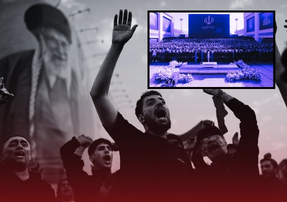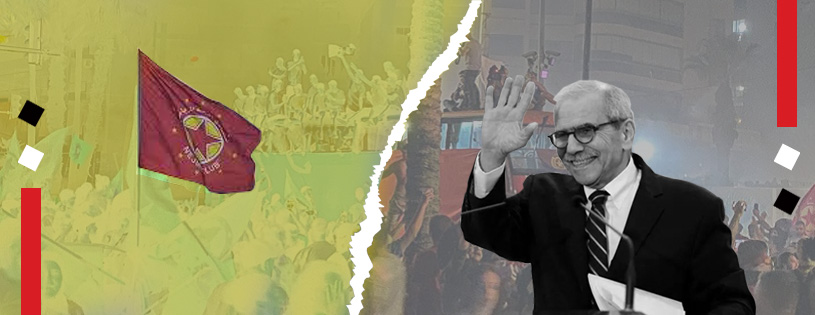
“Oh Nawaf, listen carefully... At your service, O Nasrallah,” with these words, a significant number of fans of the Lebanese Nejmeh club greeted Prime Minister Nawaf Salam during his patronage of the reopening of the Beirut Sports City Stadium after its renovation, at a match between the two giants of the Lebanese football: Nejmeh and Ansar.
This is certainly not the first time that football fans pronounce political or sectarian slogans, and it will certainly not be the last, in a country that experiences endless political, sectarian, and regional divisions.
Football stands and other sports venues are used in countries all over the world to convey political, cultural, social, or other messages. Regimes, parties, organizations, associations, and activist groups, whether in power or in opposition, can exploit large crowds to transmit their messages and ideas.
In Lebanon, football enjoys enormous popularity that surpasses any other sport. Although it is widespread in most regions, it is mainly concentrated in the capital Beirut and its suburbs. Nejmeh is the most popular team, followed by Ansar, both of which are Beirut-based clubs. They have both managed to remain competitive throughout the past decades, despite some setbacks that the two clubs have experienced, while most other clubs have emerged and vanished and then returned to the scene, due to the lack of administrative and technical stability, and because the fate of these clubs is tied to the financiers and businessmen who control them.
Lebanese Shiites, like other Lebanese, and perhaps even more so, were captivated by football. Clubs emerged in the South and the southern coast of Metn, where Tadamon Sour club was founded in 1949. Similarly, young Shiite men from the Haret Hreik area founded Shabab Al Sahel club in 1966, in addition to many other clubs in these two regions. Meanwhile, the Beqaa remained deprived of sports clubs until 1987, and interest in football there is still very weak. As a result, young boys and teenagers are deprived of the necessary training, and many talents are likely buried without anyone ever knowing about them.
Despite the spread of football clubs in Shiite villages, towns, and cities, football cheer in Lebanon is not largely subject to regional affiliations. The majority of the Shiite community supports Nejmeh Club, and a significant part supports Ansar Club, while the popularity of clubs from outside the capital is concentrated in the areas where they are active, such as Tadamon Sour and Bourj (Bourj Barajneh Club in the Southern Suburb (Dahieh)).
Although Nejmeh Club is considered a Sunni club, it has enjoyed immense popularity among the Shiites, especially among those displaced from the southern villages to the Southern Suburb (Dahieh) and some areas of the capital, such as Nabaa and Mousaytbeh. This Shiite touch got bigger in the nineties with the intense rivalry between the two main clubs of the capital, that is, Ansar and Nejmeh. Ansar is primarily Beirut’s Sunni club, particularly Tariq Jdidi area where the club is headquartered, while Nejmeh enjoyed great popularity in Chiah (Southern Suburb of Beirut), and the neighborhoods of Lija, Basta, and Khandaq Al-Ghamiq (Administrative Beirut). The division between the two fanbases deepened, especially after the assassination of the former Prime Minister Rafik Hariri and the subsequent sharp sectarian division between the fans of the two clubs.
The “Beirut Derby” between the two clubs captivated the fans, especially those who attended the match at the Beirut Sports City Stadium. The most prominent feature in the stands of both clubs was the sectarian and political chanting. Nejmeh fans repeated, “God, Nasrallah, all of Dahieh,” to which Ansar fans responded with, “God, Hariri, Tariq Jdidi,” often accompanied by harsh sectarian chants, despite the presence of non-Shiite fans among Nejmeh’s crowd and non-Sunni fans in Ansar’s stands.
Abu Mohamad, an old-time Nejmeh fan as he describes himself, says he has stopped going to the stadiums and cheering for Nejmeh because of these chants. He refuses to accept that his religious figures be insulted in front of him without being able to do anything about it. Abu Mohamad is one of many who have started avoiding attending matches from the stands, some of them share the same sectarian affiliation as the fans, but they refuse to be part of this scene.
Abbas, 34-year-old, has been a fan of Nejmeh club since childhood. He lives in the Ghobeiry area in the Southern Suburb (Dahieh) and says that he used to save money from his allowance to watch the matches of Nejmeh at the stadium on weekends, whether in Tripoli, Tyre, Jounieh, Khiara, or any other area where the club plays. Neither scorching sun nor heavy rain prevents him from attending the matches. He describes Nejmeh Club as his “childhood passion” and affirms that he will continue supporting it until the end of his life.
Abbas says that he has a calm personality and does not use foul language in his daily life, but things are different when he is in the stadium. He says, “You find yourself in a huge wave of people; you do not know where the chanting starts or who gives the order. You find yourself repeating whatever the crowd says without thinking about it; you cheer for your club’s players, you insult the opposing club’s players with racist, sectarian, or political chants - it does not matter. It is a huge wave that you cannot stop, so you go along with it. You feel the adrenaline rising and a pleasant shiver running through your body.”
Going back to the chants against Prime Minister Nawaf Salam in the stands of Nejmeh a few weeks ago, the question that is always raised is whether what the spectators say is completely spontaneous, or whether there is someone directing them, taking advantage of their spontaneity and susceptibility to being manipulated in the waves of guidance, to convey political messages and direct criticism towards opponents, and perhaps even more.
In the era of social media, political and sectarian incitement related to football is increasing, before, during, and after matches, and the Lebanese clubs are unable to fully control their fans and fan groups, and the pages dedicated to these clubs are not free from sectarian and inflammatory posts.
Before the match between Nejmeh and Ansar, which witnessed chants against Prime Minister Nawaf Salam, some well-known influencers who support Nejmeh and are regularly present in the stands were seen writing comments and posts against the Lebanese Prime Minister, creating a tense atmosphere that spread to the stadium.
Hezbollah attempted to create a fans football phenomenon through Al-Ahed club, with businessmen close to Hezbollah injecting large sums of money that elevated the club’s status and enabled it to win the league title multiple times, culminating in a historic achievement in the AFC Champions League Two.
Although a large part of Nejmeh’s fanbase supports Hezbollah politically, the Party failed to persuade them to support Al-Ahed club, despite all the political and sectarian mobilization. In the end, it seems that Hezbollah benefited from the fact that a large bloc of its organized and unorganized fans remained in the stands cheering for Nejmeh.
The failure to win over this fanbase to Al-Ahed club led to a greater focus on Nejmeh stands and an attempt to influence them through social media before matches, and through “Nejmeh” influencers who are also staunch supporters of Hezbollah and its ideology, adopting its discourses and ideology. They entice and manipulate the fans into saying with their own voices what Hezbollah sometimes cannot say on platforms or in the media.
Following the chants against Salam, a delegation from the Nejmeh Management visited him to apologize and affirm that what was said in the stands of the Beirut Sports City Stadium does not represent the views of the club or its fans. It was surprising that some fan groups objected to the visit. Reports indicated that a number of officials from the Nejmeh fan club office in the Southern Suburb (Dahieh) resigned because of this visit, reflecting the clear division within the club’s stands and the insistence of some on presenting the fans as exclusively Shiite, representing the views of the Shiite duo, particularly Hezbollah.
The martyrs of the stands and political exploitation
The recent war between Israel and Hezbollah claimed the lives of thousands of Lebanese people, and it was inevitable that many of those who died were football fans. Some activists from Nejmeh’s fanbase, who support Hezbollah, organized what they considered a campaign to honor the “martyrs of Nejmeh’s fan stands,” through a motorcycle parade that toured the Southern Suburb of Beirut (Dahieh). The organizers of the event called on the participants and the residents on the balconies to repeat the saying “We are at your service, O Nasrallah” during the celebration. This is a call with political and ideological context, signifying allegiance to the late Hezbollah Secretary-General Hassan Nasrallah, and it contradicts the slogans raised by the very same activists who are calling for this tribute, when they insist that their club is the club of the nation and belongs to everyone.
The stands of Nejmeh Club were significantly influenced by the daily political life, with the frequency of politicized and sectarian chants increasing and decreasing depending on the political situation in the country. In 2017, after a match against Al-Ahed team at the Saida Municipal Stadium, some fans organized a march on foot in the city, chanting sectarian chants such as “What is this? What is this? Shias have occupied Saida.” They also vandalized cars parked on the side of the road near the Municipal Stadium in the city, causing chaos in the city and outrage among its residents.
Regarding this incident, Salim, a Nejmeh fan from the Ras Beirut area, says that he was watching the match from the stadium stands and felt ashamed and embarrassed by the sectarian chants that were shouted during the match, and by the riots and vandalism in the area surrounding the stadium. He points out that these actions do not reflect the ethics of the Nejmeh Club, which he himself was raised on and which he has worked to instill in his children, whom he describes as “Nejmeh fans by birth.”
In the same year and at the same stadium, Nejmeh Club hosted its Jordanian counterpart, Al-Wehdat, in the group stage of the AFC Cup. During the match, Nejmeh fans chanted sectarian and religious slogans, insulted Jordanian and Palestinian figures, and attempted to assault some of the Jordanian Club’s fans who were present in the stadium stands.
There are many examples, too numerous to mention, of tensions witnessed in the stands of Nejmeh’s fans, which primarily harmed the Nejmeh fans themselves, who reject sectarian discourse and insults to religious figures and want to separate football from politics. In addition, there have been cases of car windows being smashed and acts of vandalism and unrest near stadiums, such as the case we mentioned in Sidon, and similar incidents near other stadiums, such as the Municipal Stadium in Tariq Jdidi.
Hezbollah has not hesitated to use everything at its disposal to promote and disseminate its discourse and to stir up sectarian tensions in a way that serves its interests, including sports clubs, media outlets, places of worship, religious events, schools, universities, and so on.
Football stadiums bring together thousands of spectators, but only a few dozen of them can control the way the cheering is done. The audience is emotional and easily influenced, readily repeating any phrase they hear, especially if they believe it serves the club and the situation it creates. Very few of them refrain from repeating offensive chants; hurling insults is easier when you are part of a large crowd, it is a way to vent anger and frustration and escape from reality.
All of this serves the political parties that benefit from this audience, even if what they are saying does not align with the Club’s management and history. For example, Hezbollah, and sometimes the Amal Movement, and before them the Lebanese-Syrian security regime, deliberately send messages to their opponents through the audience.
Football, among other things, aims to bring people together and reject discrimination and divisions. However, some insist on placing it in a different context. Giving the low standard of football in Lebanon and the decrease in spectator attendance, offensive chants are becoming more blatant, further deepening divisions within society.