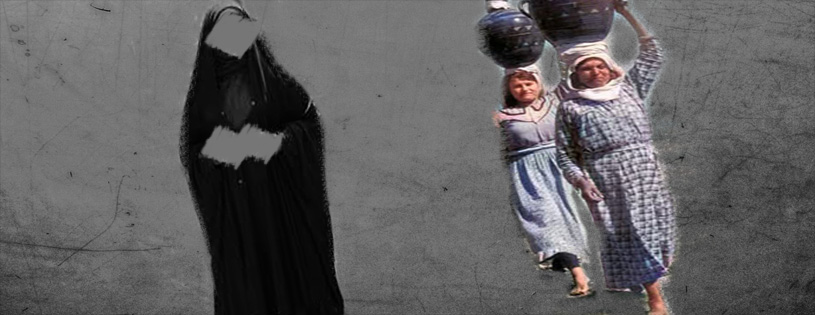
In sociology, clothing is viewed as a symbolic discourse reflecting the values and ethical standards of a community. It not only covers the body but also regulates the relationship between the individual and the group, defining the boundaries between «inside» and «outside.» When this discourse intersects with the political or religious dimension, clothing transforms into an instrument of symbolic dominance, imposing specific criteria for social acceptance and belonging.
In this context, Southern Lebanon presents a quintessential case study for analyzing the transformations in women's dress, where the hijab and the black abaya have, since the 1980s, become symbols of belonging to the «resistance environment» and a means of consolidating social and political discipline within the Shiite community.
Before the 1980s, the relationship with the body and clothing in the South was characterized by spontaneity and everyday practicality. Clothing expressed the rhythm of agricultural life more than a structured system of religious values: light cotton fabrics, vibrant colors, and practical designs that allowed for movement and work in the fields or at home.
Dress was not uniform or governed by strict religious authority, but rather varied according to local social norms and individual taste. The hijab, at that stage, was more of a social practice than a religious one, associated with the concept of social modesty rather than a strictly legal obligation. Women generally covered their heads with a light scarf that often did not completely conceal the hair, in accordance with village traditions and prevailing notions of propriety.
In this sense, the female body in the South was closer to its authentic self, unburdened by political or religious meanings, and not yet reduced to a symbolic site within a collective narrative. However, this fragile balance between tradition and personal freedom began to falter with the transformation of the South into a space of resistance and the rise of a new discourse that redefined the relationship between appearance and belonging.
With the escalation of Israeli incursions into the South and the emergence of a need for a unified mobilization discourse, the relationship with the body and clothing began to acquire new political dimensions that paved the way for the emergence of «resistance» attire.
The establishment of Hezbollah in 1982 marked a pivotal turning point in reshaping the symbolic structure of the Shiite community in Lebanon. The project was not only about military resistance but also about creating a distinct cultural and physical identity, based on the narrative of resistance as an ethical and political framework in itself.
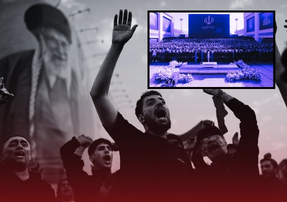
Since the mid-1980s, women's dress began to transform into an instrument of political symbolization, expressing belonging to what was termed the «resistance environment.» The hijab was no longer an individual practice but became a sign indicative of discipline and loyalty. This transformation was influenced by the Iranian revolutionary discourse and the image of the «Zaynabian» woman in post-revolution Shiite culture, where the female body became a site for ethical discipline and an indicator of ideological identity.
The spread of the black abaya in the South during this period was not merely a matter of dress but an expression of the re-production of the symbolism of the color black as a color of mourning, loyalty, and piety. Over time, this attire transformed into a visual system that separates the «inside» (the affiliated) from the «outside» (the other), and reproduces collective belonging in the public sphere.
In the 1990s, this transformation was completed with the consolidation of the image of the «Mujahida» woman, who embodies the ethical discipline of the resistance. The female body became a field for controlling collective values, and attire became part of the body representation policies practiced by the group on its members. Thus, the hijab transitioned from being a religious practice to being a political-cultural symbol testifying to the integration of religious identity into the resistance project.
Following Israel's withdrawal from southern Lebanon in 2000, the black attire acquired an established character within the southern Shiite community. It was no longer a temporary symbol of mobilization but became a stable visual identity performing a social function in affirming collective belonging.
However, this apparent stability did not negate the dynamics of internal change. Starting in the second decade of the millennium, subtle forms of negotiation began to emerge within this symbolic system, especially among the younger generations of women and girls. The question was no longer limited to the hijab itself but extended to how it was worn and what it signified. Their way of wearing it became more modern and open to colors and designs, while maintaining the collective character that indicates belonging to the Shiite environment.
In this way, this group created a distinct social state that expresses its Shiite identity in a more embellished and modern way, while remaining within the boundaries of collective symbolism that defines belonging and differentiation from others.
Pierre Bourdieu argues that what appears natural or «self-evident» in taste, dress, and the body is, in fact, the product of relations of symbolic dominance that are reproduced through everyday practice. Taste is not a free or individual choice, but rather a form of habitus, i.e., the mental and physical structure that is ingrained in individuals through socialization and drives them to adopt preferences that align with their position within the cultural structure.
In this context, women's dress, especially in religious or «resistance» contexts, becomes a mechanism for reproducing the social and gender system, through which what Bourdieu calls «symbolic violence» is translated: indirect violence that is practiced through voluntary acceptance of community standards. Wearing the abaya or hijab is not merely a religious act but a practice that produces compliance and reinforces the differences between permissible and forbidden bodies.
It is noteworthy that women themselves have contributed to the re-production of this hegemony by identifying with the image of the «Zaynabian woman» as a supreme model. Religious women were not only victims of the discourse but also active in consecrating it, by adopting its standards and evaluating other women based on them. This process reveals the mechanisms of internal social control, as women contribute to strengthening collective values through mutual observation, evaluation, and repetition of the ethical and political discourse within female circles.
These symbolic mechanisms can be observed in early socialization institutions such as the «Mahdi Scouts,» where girls' relationship with their bodies is re-formulated within the logic of collective discipline and belonging. The Scouts perform a subtle ideological function, normalizing physical and intellectual discipline from childhood.
In the ranks of girls, the hijab is not presented as a personal choice or individual commitment, but as a sign of belonging to the «Awaited Mahdi» and «Mujahida» group. Girls are raised on the notion that dress is part of faith and behavior, and that adhering to it is a symbolic participation in jihad, even before reaching political maturity. Thus, dress becomes an educational tool
of collective community, not just an external appearance, linking purity, discipline, and the resistance identity within an educational structure that is instilled from childhood.
Also, the uniform dress code inside Al-Mahdi scouts (the veil, the long dress, the dark colors) consolidates the idea of integration in the group and the disappearance of individuality, so a sentimental relationship between dress and belonging is formed.
The Women's Body in Hezbollah plays a pivotal role in consolidating this system through a dual discourse that combines religious mobilization and social upbringing. The cultural, educational, and media activities organized by the body do not only promote the hijab as a religious duty but as a symbol of identity and ethical excellence.
The body has also redefined the «Environment» as an ethically closed space where women preserve the boundaries of the community and play the role of «Guardians of Identity.» Where the female body becomes a tool to protect the community from symbolic breach, and dress is a way to control the social space under the umbrella of virtue and resistance.
With the development of the digital space, the role has not regressed but changed its tools; As it moved from the looks of the street to comments on platforms, following up on what is published on the pages of women from «the environment of resistance» shows that digital campaigns are performing the same function of collective censorship, the same bullying and moral defamation are redrawing the concept of hijab with the concepts of «Honor» and «Purity» and are re-producing the mechanisms of stigma and symbolic control in a new space.
A fundamental question arises today: Can attire change with the changing political and regional situation of «Hezbollah»?
Historically, collective symbols tend to persist even after the conditions that created them have changed, as they become a component of cultural memory. However, any change in the Hezbollah’s position or in its relationship with the Iranian reference model will necessarily re-open the debate about its cultural symbols, foremost among them the body and clothing.
Current indicators show that the transformation will not come through severance, but through slow negotiation processes led by women themselves, in an attempt to redefine the relationship between commitment and freedom, belonging and individual choice. With the shaking of the Iranian model that inspired the Zaynabian discourse, attire may shift from a symbol of collective loyalty to a space of diversity and self-expression.
For clothing in its essence is not a static entity but a system of meaning that changes with the change of the authority that grants it its significance. And when the symbolic authority changes, the form of the body it expresses also changes.